Plain Vs Spring Washers Explained: Design, Function, And Use Cases
If you’re a manufacturer looking to assemble machinery or fasten structural components, you would have mostly seen washers being used in bolted joints. Washers might seem to be really minor components, but the consequences can be severe in case you don’t select the right kind of washer for your project, as it can significantly compromise joint performance over time. Plain washers and spring washers happen to be the most routinely used washers, serving distinct purposes within an assembly.
While both washers are designed to enhance joint reliability, they significantly differ in terms of how they function, or the purposes they solve. Plain washers are great at helping distribute the load evenly along with protecting mating surfaces. On the other hand, spring washers are adept at preventing loosening of the joints in environments which are extremely prone to vibration. In applications where surface protection is critical or where dynamic forces are involved, it becomes really important to opt for the right kind of washer between the two.
In this article, we break down how both plain and spring washers work, how they are different to each other in terms of design and application, along with how to choose the right fastener for your particular application.
Plain Washer
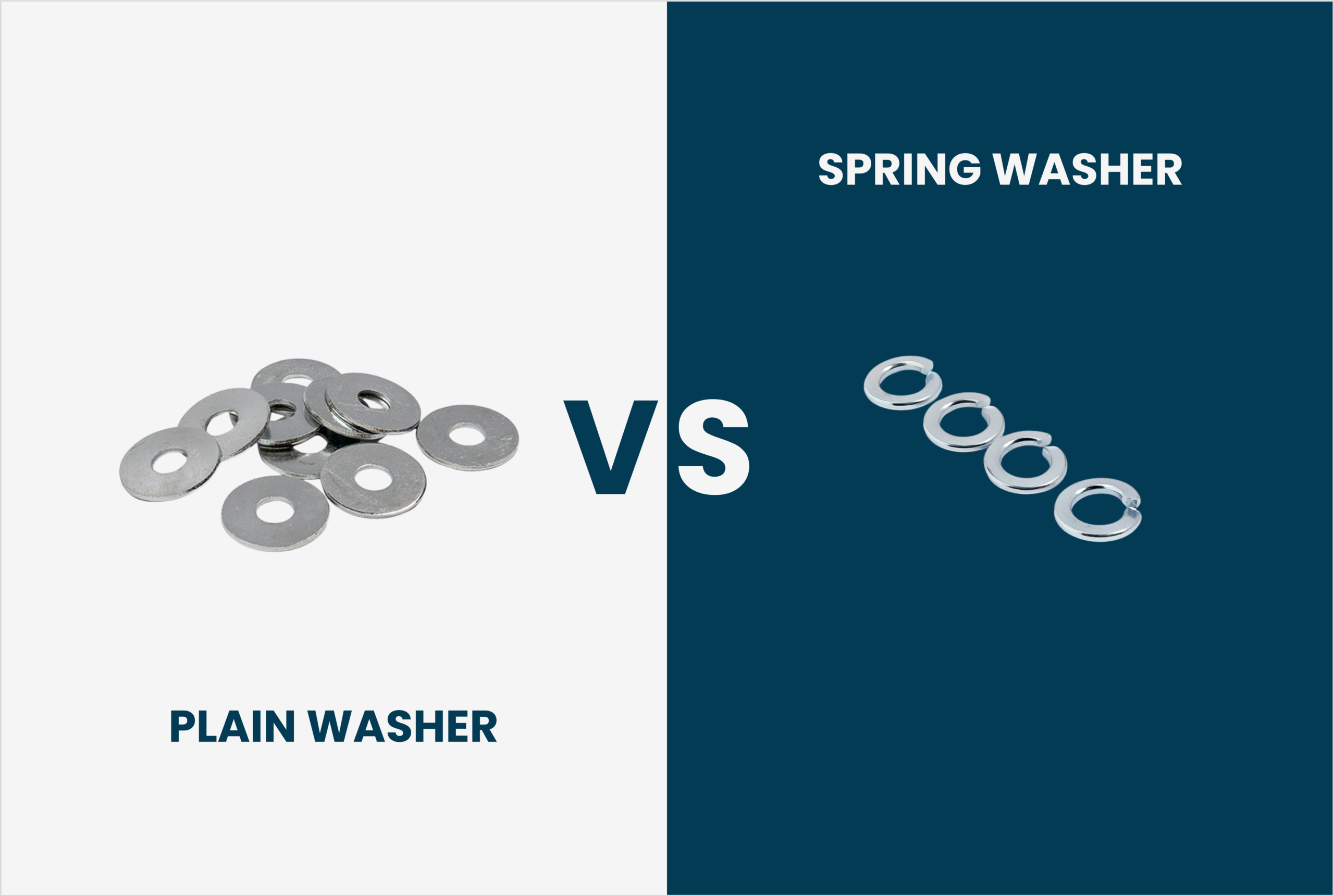
Plain washers are thin and flat discs that come with a centrally punched hole. These washers are placed beneath the bolt head or nut since it helps in distributing the load over a wider surface region. A major benefit of being able to increase the bearing surface is that it helps in reducing the risk of surface damage as well as deformation, especially when softer materials are involved.
In order for plain washers to be working effectively, it is critical for manufacturers to ensure that they are sized correctly and matched with the dimensions of a bolt. Upon being placed between the bolt and the base material, these washers are able to create an evenly distributed load bearing surface. This hugely helps in getting consistent torque which further helps in improving the overall stability of the joint.
Thanks to their uncomplicated design, plain washers are an excellent choice when it comes to being used in sheet metal assemblies, wooden structures as well as general fabrication where protecting the mating surface is of utmost importance.
At Fastener World (India), our plain washers are widely available across multiple material grades, including:
- Mild Steel Grade 4.6
- Alloy Steel Grades 8.8 and 10.9
- Stainless-Steel Grades 202, 304, and 316
These options allow manufacturers and engineers to select plain washers that align with their load requirements and environmental conditions.
Spring Washer
Spring washers are helical-shaped rings that are cut at one point and slightly twisted. When placed beneath a nut or bolt head and tightened, they compress and exert spring tension within the joint. This tension helps maintain preload and creates additional friction by biting slightly into the mating surfaces.
Owing to their design, spring washers are extremely adept when it comes to applications that need protection from loosening due to vibration. These washers are able to provide added resistance which makes them the right fit for applications commonly exposed to dynamic loads or movement.
Spring washers perform best when used against hard bearing surfaces, as softer materials may not provide sufficient resistance for the washer to function effectively. They are commonly seen in machinery, small engines, and industrial equipment where re-tightening may not be convenient or easily accessible.
At Fastener World (India), we stock spring washers in multiple material grades, including:
- Mild Steel Grade 4.6
- Alloy Steel Grades 8.8 and 10.9
- Stainless-Steel Grades 202, 304, and 316
These options allow you to select the appropriate washer based on load requirements, operating conditions, and environmental exposure.
Key Differences
| Aspect | Plain Washer | Spring Washer |
| Primary Purpose | Distributes load evenly across the surface | Resists loosening caused by vibration |
| Best Material Compatibility | Soft materials such as wood, plastic, and sheet metal | Hard metal surfaces and rigid assemblies |
| Cost | Tend to be more economical and widely available | Slightly higher due to design and function |
| Vibration Resistance | Offers minimal resistance to vibration | Provides enhanced resistance to vibration |
| Torque Consistency | Helps achieve more uniform torque during tightening | May cause slight variation due to spring tension |
| Typical Use Case | Furniture, sheet metal work, and general fabrication | Machinery, engines, and vibration-prone equipment |
Conclusion
Even though both plain washers and spring washers play an extremely important role in bolted joints, their fit largely depends on the project they’re being employed for along with the operating conditions. Plain washers are a great choice when it comes to applications requiring a wide bearing surface along with a basic level of surface protection. They are able to distribute the load evenly as well as being able to prevent any damage to the base material being used, making them apt for general fabrication and structural usage.
Spring washers on the other hand are far better suited for applications which are susceptible to loosening over time owing to vibration or movement. These washers are designed in a manner which provides enhanced grip and stability against resistance, allowing for the joint to be a lot more stable in tough environments.
Eventually, the decision between the two washers boils down to whether the application needs surface protection or prefers protection against loosening. A good understanding of the requirements of the project can allow manufacturers to be able to pick the right type of washer that plays a huge role in the performance and service life of the fasteners.
At Fastener World (India), we stock both plain and spring washers across a wide range of sizes, material grades, as well as protective coating options, enabling you to select the most appropriate solution for your needs.