Self-Tapping Screws Explained: Head Types, Uses & Applications
Introduction
For projects and applications that require reliable fastening solutions with little to no preparation, self-tapping screws usually tend to be the go-to option for any manufacturer. These screws are able to create their own threads since they have the ability to drive into a pre-drilled pilot hole, which in turn helps in providing fast and reliable joints in materials like sheet metal, plastics and timber.
Since these screws have the ability to remove the need for there to be any tapping tools or additional thread-cutting steps, they turn out to be a great option for high-efficiency assembly lines, field installations, as well as maintenance work. As a result, self-tapping screws are widely used in electrical enclosures, HVAC systems, and automotive panels.
Within the self-tapping screw family, the head style along with the bearing surface has a huge say on how the screw looks, how it is able to spread the load and how easy or difficult it is to install. Below is a quick guide to the various types of self-tapping screws that we offer and when each would prove to be an appropriate choice.
Pan Head Self-Tapping Screw
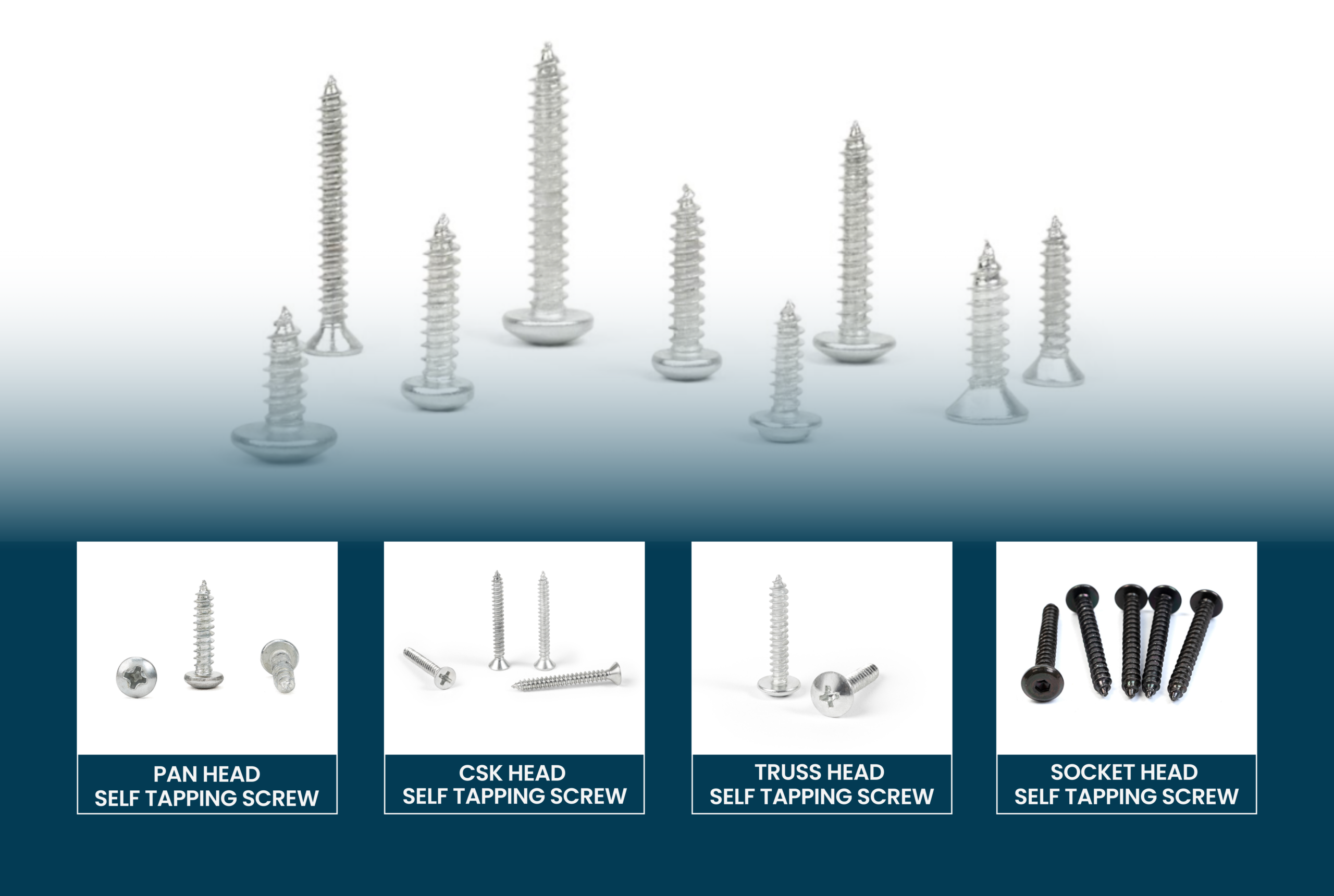
These Pan Head Self-Tapping Screws tend to be a general-purpose choice that come with a rounded, low-profile head along with a broad bearing surface. The pan head is easy to drive and can also distribute load well without needing to dig into the base material. They are an excellent choice for applications across electrical enclosures, brackets, appliance panels, and general sheet-metal work where a neat and visible head is acceptable along with moderate torque capacity.
CSK Head Self-Tapping Screw
Countersunk screws are designed in a manner that allows them to be able to sit flush with the surface upon their installation. The tapered head pulls into a countersunk hole, which leaves a smooth and snag-free finish. These screws are ideal for applications involving hinges, hardware fittings, along with assemblies where appearance and clearance matter like door panels or fixtures that need a flat surface for sliding parts or coverings.
Pan Head with Washer Self-Tapping Screw
In pan head with washer self-tapping screws, pan head is combined with a pre-assembled washer to spread clamping force and protect softer materials from any form of pull-through. Due to the presence of an integrated washer in the screw, the assembly process is also much quicker, which in turn results in fewer loose parts and helps in sealing larger holes. These screws are an excellent choice for applications involving thin sheet metal, plastics, and light HVAC ducting.
Truss Head Self-Tapping Screw
Truss head self-tapping screws come with a wider, low-domed head that is able to offer maximum bearing area along with a neat finish. These screws are able to reduce the risk of tearing by covering the oversize slots well. As a result, truss head screws are a great choice for applications like signage, interior fittings and cable trays where broad clamping without countersunking is required.
Socket Head Self-Tapping Screw
Socket Head Self-Tapping Screws use an internal hex drive that allows for better torque control as well as higher tool engagement in tight spaces. The smaller head diameter of the screw is also extremely adept in helping with clearance around guards or recesses. Socket head self-tapping screws are a great choice for metal to metal joints, machinery covers and service panels where compact and strong drives are preferred.
Flange Phillip Self-Tapping Screw
A flange head self-tapping screw comes with an integrated rim that is beneath the head of the screw which works in a similar manner to a washer, since it is able to automatically spread the clamping load across a wider surface area. Owing to there being a flange that has already been built-in, it completely removes the need for there to be a separate washer, which in turn significantly eases the entire process of installation. The Phillips drive makes tooling straightforward and widely compatible with standard drivers. Additionally, the wide flange that is present in the screw also plays an important role in helping safeguard coated or painted surfaces from any form of damage that they may occur while also improving the load distribution across the surface in sheet metal and light structural applications.
Conclusion
Picking the right kind of self-tapping screw largely comes down to the needs of any particular application. Pan head self-tapping screws are great when it comes to offering reliable load distribution across the surface, which makes them extremely appropriate for general sheet-metal applications. CSK head self-tapping screws are known to be able to provide a flush finish when it comes to hinges, fittings, and sliding components where appearance is of much greater importance. Truss head self-tapping screws are able to offer broad clamping without the need for countersinking, especially relevant for thin materials as well as signage installations. Socket head screws are able to provide greater torque control in compact applications while flange Phillips screws are able to combine quicker installation with greater surface protection.
At Fastener World (India), we stock different types of self-tapping screws in a wide range of sizes and material grades, allowing manufacturers and engineers to select the right fastening solution for their particular application.