Wedge Anchors Vs Sleeve Anchors: Design, Strength & Applications
Introduction
Fasteners are very important for the safety and lifespan of buildings in construction and industrial operations. Sleeve anchors are often used to hold up handrails, window frames, shelves, and signs when some flexibility and medium-duty strength are needed. They are especially helpful for retrofitting projects or installations in masonry walls where a strong concrete anchor may not be possible since they may work in hollow or less-dense materials.
Wedge anchors work best in solid concrete because the expansion mechanism can provide the most holding force. Wedge anchors may not work as well in materials like brick, block, or hollow concrete, whereas sleeve anchors are designed to work with these types of surfaces. Because they may be used with many different materials and because the wall construction doesn’t allow for deep drilling, sleeve anchors are a popular option for projects like these. The way wedge anchors and sleeve anchors are installed and expanded is one of the biggest distinctions between them. Wedge anchors need to fit perfectly and expand within solid concrete, thus the hole has to be bored to the right depth and diameter for best results.
Sleeve anchors, on the other hand, may hold more types of materials and holes that aren’t perfectly round since their sleeves expand outward. This makes it simpler to place sleeve anchors in a variety of situations, but they may not be as strong as wedge anchors when used in solid concrete. Another important difference is how much weight it can hold. Wedge anchors are designed to support enormous weights and stand up to both shear and tensile pressures. Because of this, they are the best option for building and installing machines.
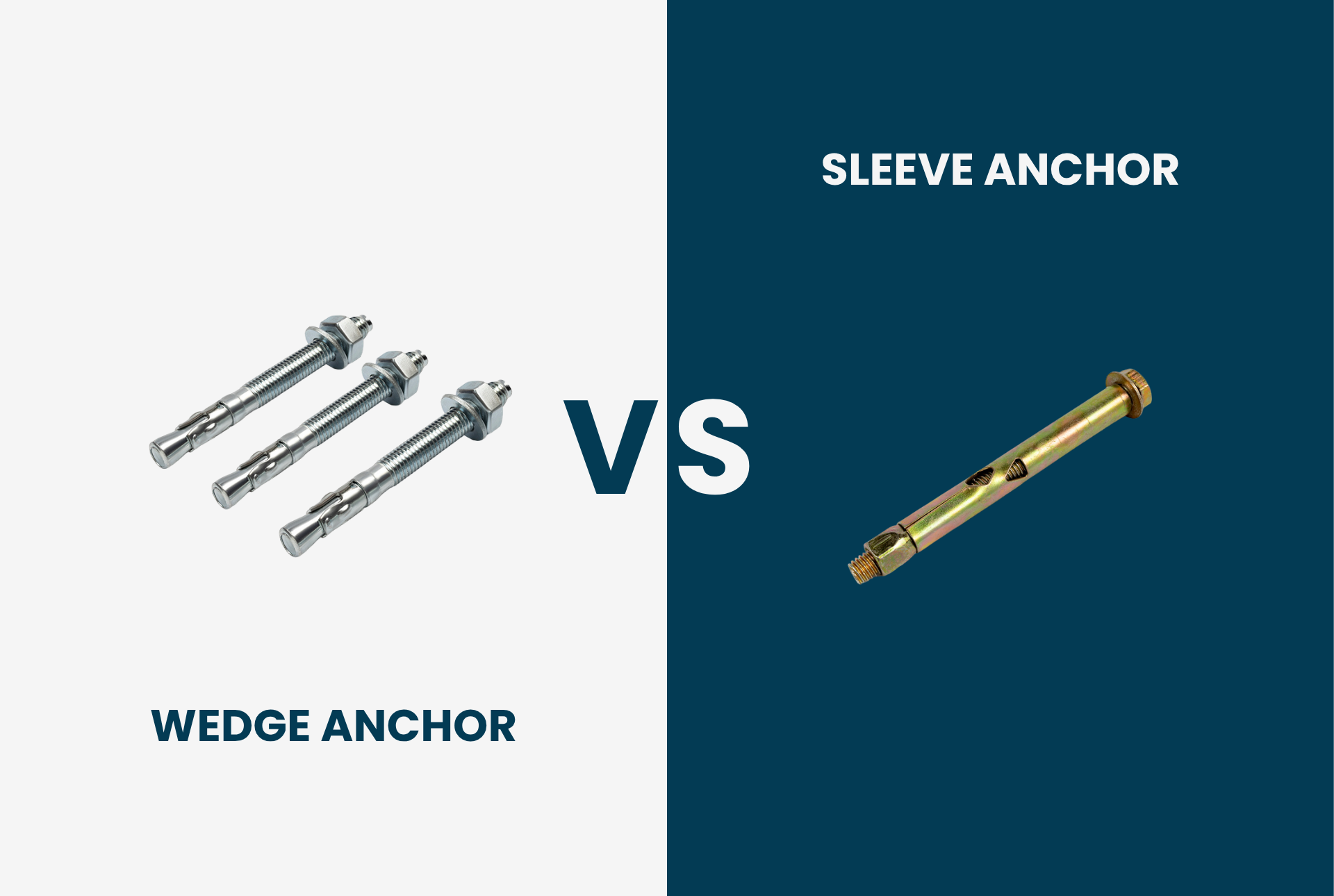
Wedge Anchor
Wedge anchors work best in solid concrete, although sleeve anchors may be used in concrete, brick, block, and stone. Wedge anchors are mostly used in heavy-duty construction and industrial operations. They are great for important structural attachments because they retain better and are less likely to break under stress. Some popular applications include holding steel columns, equipment bases, structural beams, guardrails, and other fixtures where safety and dependability are very important. Wedge anchors are very beneficial where there are moving loads or vibrations, such in industrial machines or mechanical systems.
Sleeve Anchor
There are more distinctions between wedge anchors and sleeve anchors than just the materials they work with. The load capacity is very important. Wedge anchors are designed to hold big loads and work best in situations where both tensile and shear pressures are present. Sleeve anchors are powerful, although they work best in medium-duty applications. Because they are so flexible and useful, sleeve anchors are used in a lot of homes and businesses. They work well for medium-duty jobs that require a secure fastening but don’t need to hold a lot of weight. Handrails, window and door frames, signs, storage units, and ornamental fixtures are all things that people often utilise them for.
Key Differences
| Aspect | Wedge Anchor | Sleeve Anchor |
| Base Material | Designed specifically for installation in solid concrete, where the anchor can develop its full expansion strength and load capacity | Suitable for multiple masonry substrates, including concrete, solid brick, hollow brick and concrete brick |
| Load Capacity | It’s great for heavy-duty installations and anchoring things to solid concrete because it’s so strong. | Offers moderate load capacity, suitable for medium-duty applications where extreme strength isn’t required |
| Hole Size | The drilled hole diameter matches the anchor diameter, ensuring a tight mechanical fit before expansion occurs | Usually requires a slightly larger hole to accommodate the expansion sleeve, which spreads along the anchor body |
| Expansion Area | Expansion occurs primarily at the tip of the anchor, where the clip expands outward to lock into the concrete | Expansion occurs along the full length of the sleeve, distributing pressure more evenly across the hole wall |
| Best For | Best for heavy fixtures and structural installations such base plates, machinery mounts, guard rails, and connections between structural steel. | Ideal for general fastening across mixed substrates, including brackets, handrails, electrical fixtures, and medium-duty installations. |
Conclusion
The sorts of loads that each anchor can hold up are also an important part of the comparison. Wedge anchors work best in situations where there are large tensile and shear stresses because they directly interlock with solid concrete. They work especially well in structural and heavy-duty situations where there are loads that change or are caused by vibrations. There are a number of criteria that affect the choice between wedge and sleeve anchors. These include the kind of substrate, the estimated load and stress, the environment, the permanency of the installation, and the importance of the fixture being secured. Wedge anchors, on the other hand, are made for jobs that need the most strength, durability, and resistance to changing loads. By using both kinds of anchors in this way, each part of a building project is held in place according to its own load, material, and environmental needs.For high-load, permanent installations in solid concrete, engineering rules say that wedge anchors should always be used to make the installation as safe and effective as possible.
Sleeve anchors are very useful for retrofitting, remodeling, and building with more than one kind of material. Wedge anchors need firm concrete to work best, although sleeve anchors may hold fixtures in places where the substrate strength or surface is uneven. When used with the right installation method and substrate preparation, wedge anchors work well enough to keep things stable for a long time and need little maintenance. We provide a large choice of sizes, finishes, and material grades of both wedge anchors and sleeve anchors at Fastener World (India). Our range is designed to satisfy the needs of varied construction, fabrication, and industrial uses while making sure that it works well with a wide range of materials. The decision between wedge and sleeve anchors may have a big effect on the safety, durability, and success of building projects if you carefully consider the needs of the application.