Coarse Threads vs Fine Threads: Key Differences and Applications
Threads are critical components in mechanical design, directly influencing how parts are joined and how loads are transferred. They are essential to how parts are joined, held, and kept in good shape in a wide range of situations. Threaded fasteners are essential for mechanical assembly because they keep parts tightly joined under different levels of stress, pressure, and weather exposure. They are widely used across industrial equipment, automotive systems, and construction structures. Even though they look easy, threads are the result of careful engineering that combines mathematics, material science, and load distribution principles to make sure they work well in the real world. Threads are basically spiral lines wrapped around a cylinder. They are made to turn rotational motion into linear force, which is what tools like screws and bolts do to hold things together firmly. But the pitch of the thread, which is the space between neighboring thread crests, has a big effect on how well this process works.
Understanding thread types is important for more than just connecting things together; it’s also important for mechanical efficiency and structure stability. When you don’t choose the right thread type, it can cause the system to fail early, damage materials, or not distribute loads properly, all of which can make it less safe and less effective. For instance, using fine threads in a soft material could cause the threads to strip because the depth isn’t deep enough. Threads are more than just inactive links; they also spread mechanical forces around the structure. It is better for softer materials because coarse threads spread stress over fewer but deeper contact points. This difference in how stress is distributed is a big part of how long a fastener will last when it is used a lot or when it is loaded and unloaded quickly.
Aside from how well it works mechanically, fitting and care also play a big part in choosing the right thread. Because they have a bigger pitch, coarse threads are usually easier to install because they can connect faster and are less likely to be out of line. In the field, where time and ease of use are important, this makes them very useful. For better contact, fine threads need to be installed with more care, often requiring careful alignment and controlled pressure application. But if they are put properly, tiny threads often offer better long-term security and need to be adjusted less often in controlled settings. Because they are simple, strong, and flexible, coarse threads are great for general uses and lighter materials.
Coarse Threads
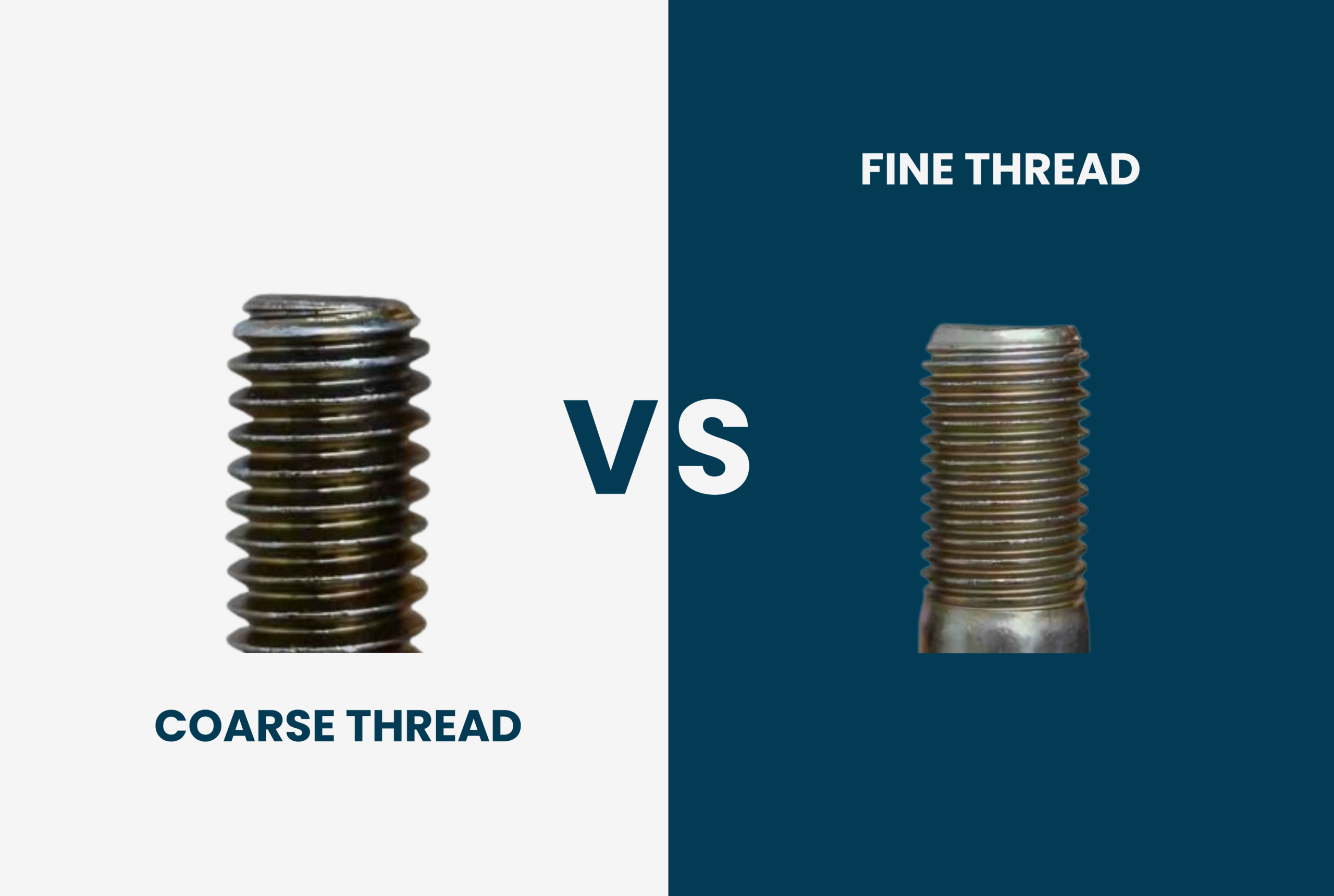
Broader thread flanks are able to grip soft materials like wood and aluminium without stripping. These can often be seen across bolts used in holding together scaffold frames, structural brackets and even furniture kits., wherever quick fastening and durability are of paramount importance, even in less than ideal conditions. This can make them less resistant to coming loose when they are vibrated continuously unless extra locking devices are used.
Also, they might not be as strong as fine threads when it comes to tensile strength in metal-to-metal situations that need the most binding force. Coarse threads are still one of the most popular ways to hold things together because they are durable, easy to use, and can be used with a lot of different materials and situations. Because they work consistently even in less-than-ideal situations, they are an important choice for building, general engineering, car fixes, and home uses where power and ease of use are both important.
Fine Threads
Fine threads are often utilized in situations where accuracy, strength under stress, and resistance to vibration are all important. Their design lets the mating threads touch more of the surface, which makes the grip stronger in certain situations. But they need extra attention while being installed since their finer structure makes them more likely to be cross-threaded or damaged if they aren’t lined up correctly. Fine threads have a smaller size and more threads per unit length. This means that the fastener and the material it fits into have less space between them and more touch points. This design gives you more exact control when tightening, which makes fine threads perfect for tasks that need to be accurate, strong, and stable.
Fine threads make metal-to-metal links stronger because they spread the load more widely across the fastening because more threads are engaged at the same time. They are perfect for high-performance uses like car engines, aircraft parts, precise machinery, and industrial equipment that needs a constant holding force because of this. Another important benefit of small threads is that they are less likely to come loose when they are vibrated. It helps keep things stable in places where there is steady movement or mechanical shaking because the tighter pitch increases friction and makes the locking effect stronger. Fine threads are also useful in engineering where precise force application is needed because they make it easier to control torque because smaller changes in spin lead to more precise changes in tension. Fine threads are utilized a lot in automobile engineering, aerospace systems, and precise manufacturing where strength and resistance to vibration are very important. They are good for engine parts, hydraulic systems, and high-performance mechanical assemblies where failure is not an option because they can maintain tight tolerances.
Key Differences
| Aspect | Coarse Thread | Fine Thread |
| Pitch | Wider thread spacing, resulting in fewer threads per unit length | Narrower thread spacing, resulting in more threads per unit length |
| Assembly Speed | Faster to install due to larger thread spacing and easier engagement | Slower installation as finer threads require more turns and precise alignment |
| Tensile Strength | Standard tensile strength suitable for general purpose applications | Higher tensile strength due to increased thread engagement and contact area |
| Soft Material Grip | Excellent grip in softer materials like wood, plastic and low-density metals | Limited grip in softer materials, may strip threads if not used properly |
| Dirt Tolerance | High tolerance to dirt, and debris | Low tolerance, finer threads can get damaged more easily |
| Typical Uses | Commonly used in construction, and general fabrication | Preferred for precision components, and automotive assemblies |
Conclusion
Coarse threads are easy to use, last a long time, and can be used in many ways. They work great in wood, plastic, and softer metals where stronger contact is needed to keep them from pulling or breaking because of their bigger pitch and thicker thread profile. Fine threads, on the other hand, are made to be precise, strong when stretched, and very resistant to shaking. Because their diameter is smaller, more threads can contact at the same time. This makes load distribution better and binding efficiency higher in metal-to-metal uses.
At Fastener World (India), we offer both thread styles in a wide range of sizes, materials, and finishes, ensuring you find the right fastener no matter what your application demands.