Fasteners for Furniture Manufacturing: Selection Guide
Fasteners are an integral part of furniture production as they attach various components firmly and provide strength, stability and longevity of the end product. Whether it is household furniture, office furniture, modular furniture or industrial storage systems, the success of the assembly relies on the quality and appropriateness of the fasteners used.
Furniture fasteners will also have to provide simplicity of installation , clean look and dependable holding power . For many applications other criteria like corrosion resistance, vibration handling and frequent installation and disassembly become as crucial. Choosing the correct fasteners improves the quality, longevity, and user experience of furniture.
Importance of Fasteners in Furniture Manufacturing
Fasteners are used in residential, commercial, office, hotel and industrial furniture and directly contribute to strength, durability, stability and long term performance. From chairs and tables to cabinets, beds, storage units and modular furniture systems almost every item of furniture relies on dependable fastening methods. Modern furniture design also places a lot of emphasis on aesthetics, mobility, modularity and simplicity of assembly. Fasteners meet these needs by allowing designers to develop strong joints with neat designs and fast manufacturing processes.
Many kinds of furniture nowadays are meant to be shipped and assembled by the client, which makes trustworthy fastening mechanisms that much more crucial. There are many different shapes and forms of furniture fasteners including screws, bolts, nuts, washers, dowels, connectors, hinges, brackets, cam locks and unique fittings. The function of each kind is determined by the material, the load requirements and the style of design of the furniture.
Fasteners provide structural support, but they also impact production efficiency, maintenance, repairability and product life. Poor quality fastening systems may result in weak joints, creaking, structural failure and customer unhappiness. As the furniture production sector continues to evolve with new materials, automation and current design trends the need for dependable and durable fasteners continues to grow throughout the worldwide furniture industry.
Factors to Consider When Selecting Furniture Fasteners
Reliable fasteners help maintain secure connections and improve overall stability. Modern furniture manufacture uses a broad range of materials, including solid wood, engineered boards, metal, glass, plastic and composite materials. different materials have varied fastening solutions depending on the strength, thickness and load bearing capabilities. Furniture design trends may affect fastener choices. For the minimalist and contemporary furniture, the aesthetic properties of the furniture need the use of hidden attaching systems, while for the modular furniture the fastening systems are based mainly on the use of removable connections and easy-to-assemble fasteners.
Production efficiency, simplicity of installation, maintenance needs, corrosion resistance and long-term durability are all factors that furniture fasteners manufacturers need to consider when choosing. For commercial furniture, office furniture and high-use situations, where items are subject to increased wear and mechanical stresses, the choice of fasteners becomes even more critical.
Materials and Finishes Used in Furniture Fasteners
Today furniture production encompasses a vast array of furniture kinds including timber furniture, aluminum furniture, modular furniture, office furniture, outdoor furniture and hospitality furniture. Fasteners are required for every application to execute certain functions. Steel is one of the most common materials used for furniture fasteners due to its great strength, durability and low cost. Strong mechanical performance is often needed in residential furniture, office furniture, storage systems, beds, cabinets, tables and industrial furniture applications, where steel fasteners are often employed. Cost and adaptability make carbon steel fasteners a particularly attractive choice.
They are available in a variety of sizes, thread kinds and styles to fit a range of furniture uses. But steel that is not treated will rust if moisture and humidity are present. Steel furniture fastenings are often paired with protective treatments such as zinc plating, black oxide coatings or powder coatings to increase corrosion resistance for this reason. Fasteners made from high strength steel are often used in commercial furniture and in heavy-duty applications where optimum durability is needed.
Reinforced steel fastening methods are often used in office chairs, industrial shelving and hospitality furniture. Steel fasteners are very suitable for automated furniture production processes because of the dimensional stability and installation performance. Steel is sometimes heavier than some other materials, but because of its strength and longevity it is one of the most reliable alternatives for structural furniture connections.
Types of Fasteners Used in Furniture Manufacturing
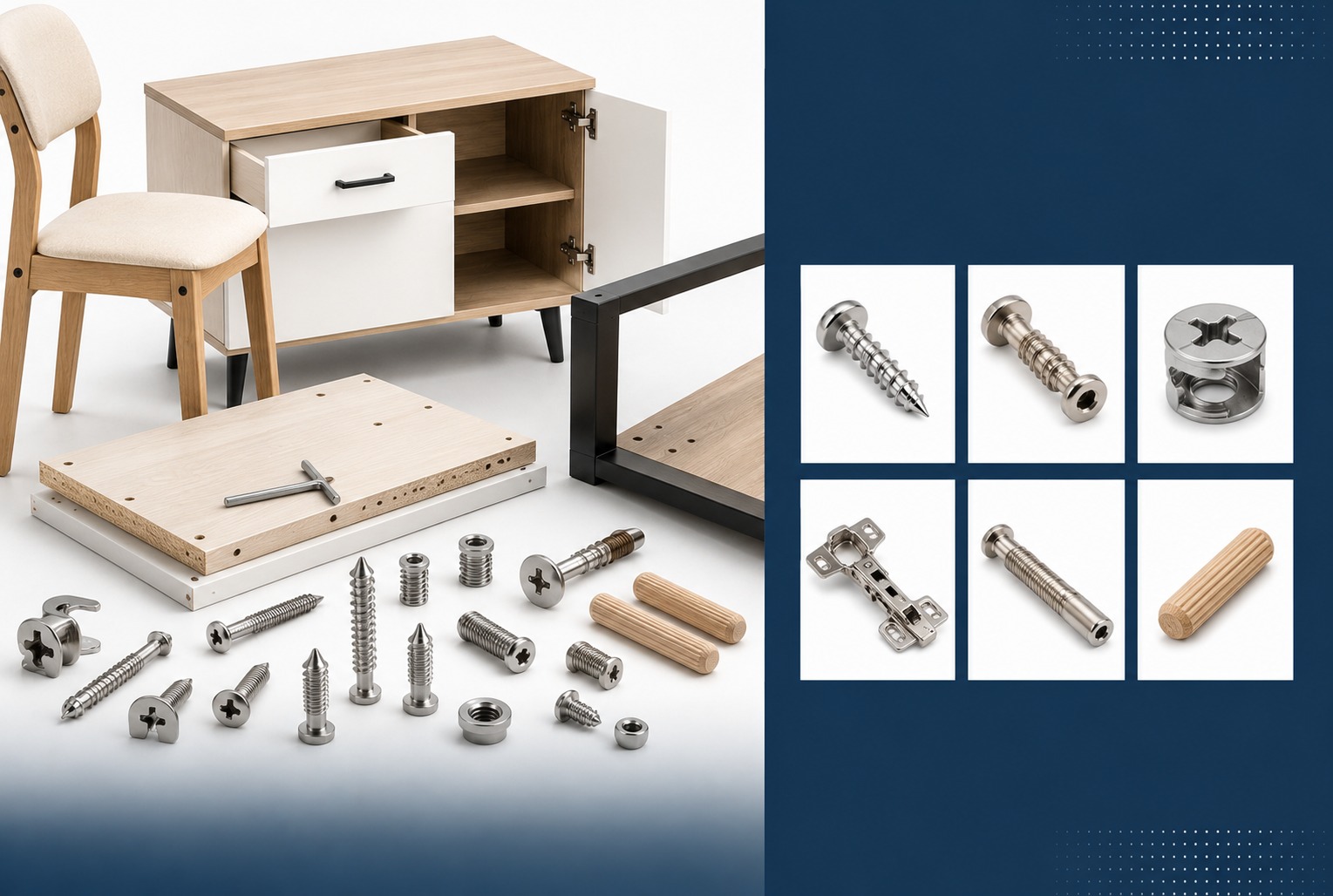
A wide variety of fasteners are used in furniture manufacturing based on the assembly method and application requirements. Wood screws are among the most commonly used fasteners because they provide strong holding power in wooden materials and are easy to install. Chipboard screws are widely used in MDF, particle board and engineered wood applications.
Their thread design allows better grip in softer materials commonly used in modular furniture manufacturing. Confirmat screws are frequently used in flat-pack and modular furniture because they provide strong joints and good alignment in particle board and MDF assemblies. Bolts and nuts are commonly used in furniture frames, metal furniture and applications requiring higher structural strength. Allen bolts are also widely used because they provide clean appearance and reliable fastening in compact spaces.
Threaded inserts, cam fittings and connector bolts are often used in ready-to-assemble furniture systems where repeated installation and disassembly may be required. Washers, brackets and anchor fasteners are also used to improve load distribution and joint stability in furniture assemblies.
Choosing the Right Fastener for Long-Term Furniture Performance
The rising popularity of modular furniture, flat pack systems, low weight construction and modernist minimal design has raised the need of choosing proper fastening solutions. Furniture fasteners of today must satisfy criteria not only for structural durability, but also aesthetic, ease of assembly and maintenance.
Selecting fasteners appropriate to the application, materials, environment and predicted use levels is critical to long term furniture performance. Knowledge of the proper fastener to use assists furniture producers, designers and customers in that it leads to stronger, more durable furniture, cuts down on maintenance difficulties and results in safer, more dependable furniture.
At Fastener World (India), we provide a wide range of furniture fasteners including wood screws, chipboard screws, bolts, nuts and stainless steel fastening solutions for different furniture applications. Selecting the correct fastener helps improve furniture strength, appearance and long-term performance across residential, commercial and industrial environments.