SS 304 vs SS 316 Fasteners: Which Grade Should You Choose?
Introduction
SS 304 and SS 316 are quite similar, although they vary in chemical composition, corrosion resistance, cost and best uses. Getting the improper grade may eat away early, drive up maintenance costs, or be a waste of money. It is thus of paramount importance that engineers, procurement managers, manufacturers and anybody else engaged in choosing a fastening solution understand these distinctions.
What Are SS 304 Fasteners?
SS 304 is commonly referred to as the workhorse grade when it comes to stainless steel. It has the distinction of being one of the world’s most popular stainless steel grades due to its superior mix of corrosion resistance, strength as well as cost-effectiveness.
Their mechanical strength and their pleasant look make them frequently utilised in architectural constructions, in culinary equipment, in machinery, in pipelines, and in industrial assembly. Due to their good formability and weldability, they may be easily manufactured in various sizes and designs to suit the needs of different applications.
SS 304 fasteners are very good in indoor and mildly corrosive situations. They resist exposure to fresh water, climatic conditions and many common chemicals. They are an economical alternative for general-purpose attaching applications. However, in high chloride environments such as coastal locations or in marine applications, SS 304 may be vulnerable to pitting corrosion. In such instances, SS 316 fasteners are often used because to their greater resistance to seawater and corrosive substances.
SS 304 fasteners are generally regarded as the industry standard for applications needing a mix of corrosion resistance, strength, cost effectiveness, and simplicity of manufacture. Proven performance and availability make them a reliable solution for many fastening applications in the residential, commercial and industrial markets.
What are SS 316 Fasteners?
SS 316 bolts have good mechanical qualities such as high tensile strength, hardness and endurance across a wide temperature range, in addition to their corrosion resistance. They have good strength at increased temperatures and are resistant to low-temperature cracking situations. Due to their non-reactive and hygienic nature, they are also ideal for cleanroom settings and applications with rigorous sanitary requirements.
SS 316 bolts are more costly than SS 304 bolts owing to the presence of molybdenum and the greater alloy percentage. However, the increased service life and less maintenance needs often outweigh this cost. SS 316 bolts are well suited for locations where seawater, chemicals or harsh circumstances are a problem. They are a solid performer for the long haul.
Difference Between SS 304 And SS 316 Fasteners
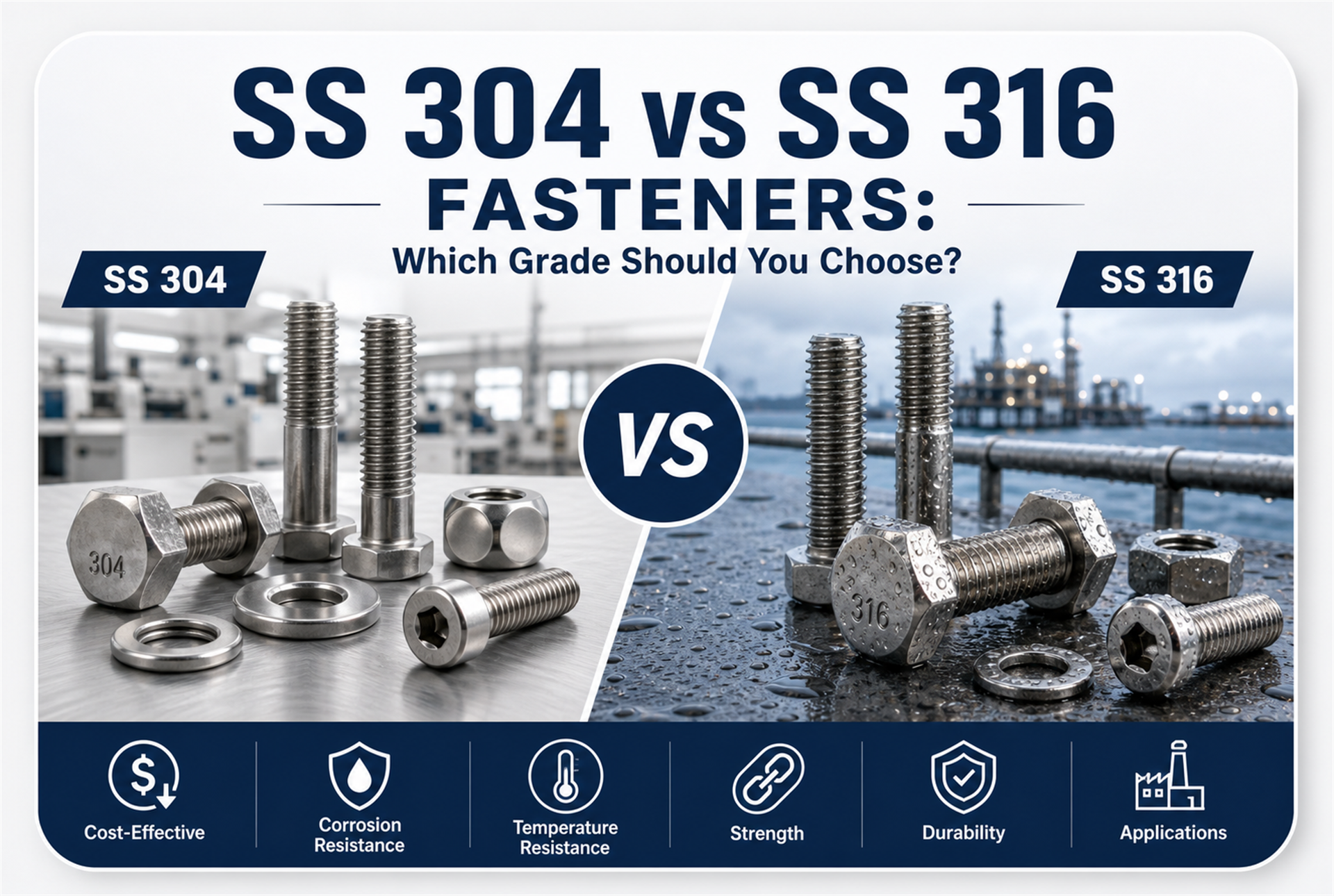
SS 304 is ideal for typical industrial and commercial applications. SS 316 is preferable for coastal locations, marine applications, chemical plants and settings where fasteners may be subjected to salt, moisture, acids or cleaning agents.
The two grades seem quite similar. That is why it is crucial to check the material quality when you purchase the fasteners. Buyers should always examine the material test certificates or grade requirements for important applications to ensure the proper stainless steel grade is chosen.
Corrosion Resistance
SS 304 is suitable for various common circumstances and resists rust better than mild steel or plated fasteners. It is a fantastic choice for interior applications, dry locations and applications that are not exposed to much moisture.
Strength and Longevity
SS 304 Fasteners and SS 316 Fasteners are both strong in mechanical strength and durable. For many conventional applications, the difference in strength between the two classes may not be the decisive factor. Instead, what seems to matter more is the work atmosphere.
SS 304 fasteners have suitable strength for the general fabrication, machinery, furniture and equipment assembly. They can carry normal loads and offer long-lasting fixing under the correct circumstances.
SS 316 fasteners are likewise high in strength but the key benefit is improved durability in corrosive situations. When the fastener will be exposed in the long term to moisture, chemicals, or external weather, SS 316 may increase the service life.
Difference In Cost
Cost is another key consideration for procurement teams. SS 304 fasteners are less expensive than SS 316 fasteners. This makes SS 304 a good option for general-purpose use where great corrosion resistance is not needed.
The least expensive fastener may not be the most cost-effective. If a fastener breaks prematurely due to rust, the overall cost of replacement, labour, production delay and safety risk might be substantially greater. Hence the grade should be determined on the basis of application circumstances and not only on the price.
Typical Uses of SS 304 Fasteners
SS 304 Fastener Applications are:
- General engineering uses
- Plant and equipment erection
- Furniture manufacture
- Electrical enclosures and panels
- Auto parts
- Building work inside
- Light manufacturing
- General industrial maintenance
These applications generally need strong strength and mild corrosion resistance, SS 304 is a good choice and economical.
Typical Uses of SS 316 Fasteners
SS 316 fasteners are used in:
- Marine and coastal applications
- Chemical processing plants
- Food and beverage equipment
- Medical equipment
- Water purification plants
- Structures exposed to dampness outside
- Wet environments
- Applications using acids or chemicals with salt
In many situations, corrosion resistance is more essential than initial cost. SS 316 fasteners assist in increasing dependability and minimising the possibilities of failure.
What Grade To Select?
For applications exposed to maritime environments, chemicals, excessive humidity, salt air or frequent dampness, it is recommended to use SS 316 fasteners owing to better corrosion resistance as well as durability.
For many customers, it’s about the environment. For usage in a regular environment, SS 304 is often enough for the fastener. If the fastener is going to be utilised in a hostile or corrosive environment, SS 316 is the safest choice.
Conclusion
Both SS 304 and SS 316 fasteners are dependable stainless steel choices but they are intended for various operating environments. Buyers should consider the environment, load required, exposure to chemicals, projected life of service and overall cost of maintenance when choosing the grade. Choosing the proper grade of stainless steel gives higher performance, longer life and safer assembly.
Fastener World (India) will assist you in choosing the proper quality, size and standard according to your application for bulk needs of stainless steel bolts, nuts, screws, washers and other fasteners.