How To Choose The Right Anchor Fastener For Concrete Applications
Introduction
Anchor fasteners are used to anchor fixtures, structures, brackets, machines, railings, frames or supports into concrete, brick, stone or masonry. Anchor fasteners are meant to provide a firm grip inside a base material, unlike typical bolts and screws. As a result, they are valuable for building, fabrication, electrical installation, plumbing, HVAC, industrial equipment and infrastructure applications.
Concrete is quite strong under compression, yet to attach anything to concrete needs the correct sort of anchor, size, depth of embedment, and installation procedure. The fastening may loosen, break the foundation material or fail under weight if the improper anchor is used. This might lead to safety concerns, repair costs and project delays.
The choice of the proper anchor fastener relies on a number of parameters such as load requirement, base material, fixture thickness, installation situation, corrosion exposure and whether the load is static, dynamic or vibrating. This article will assist you in choosing the proper anchor fastener for your concrete application.
What is an Anchor Fastener?
Anchor Fasteners An anchor fastener is a fastening component used to connect things to concrete, masonry, brick or stone. They extend, hold, or lock in the drilled hole. Once in place, they offer a secure connection between the fixture and the base material.
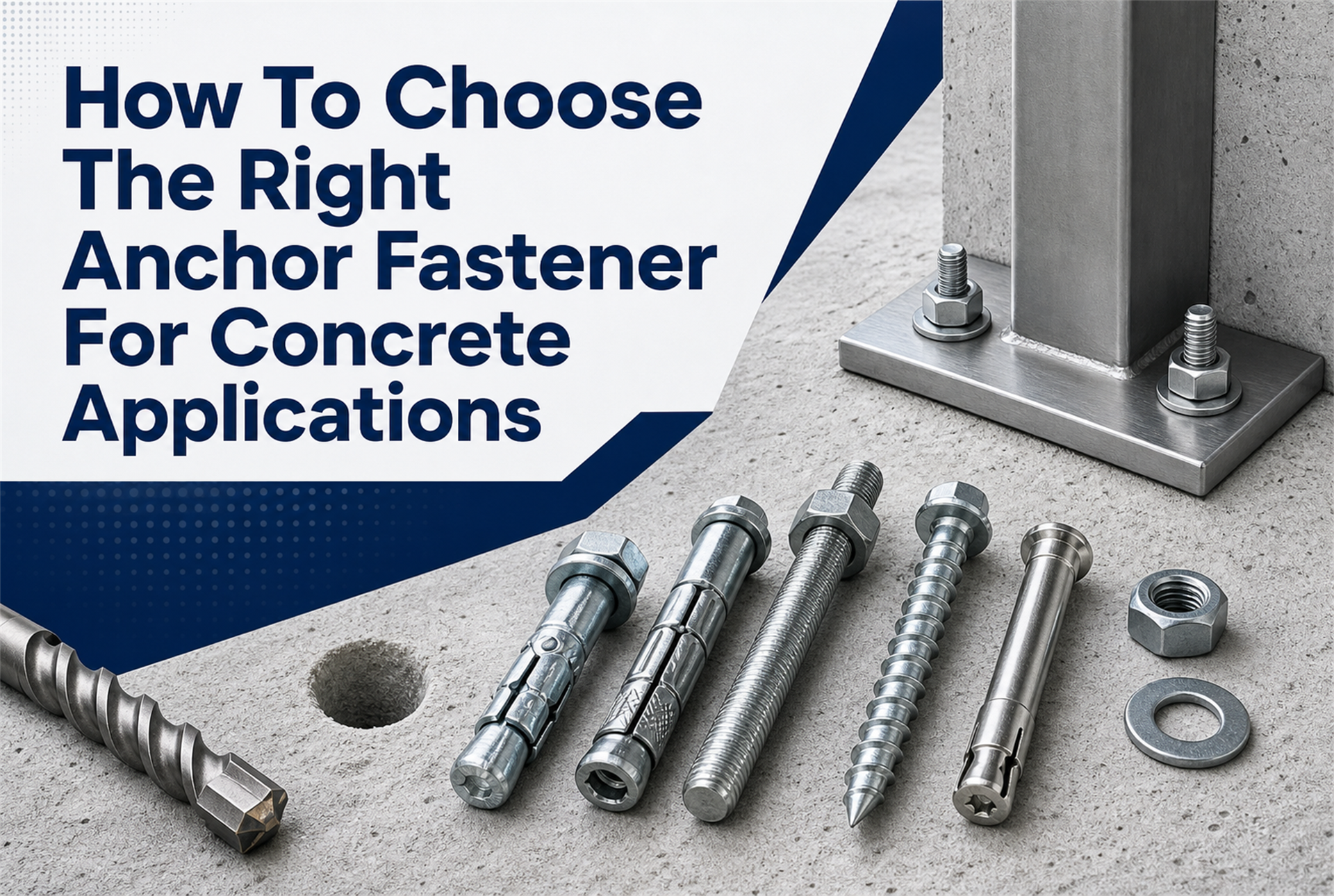
Typical anchor fasteners include wedge anchors, sleeve anchors, rawl bolts, pin type anchors, frame fixes and chemical anchors. Each kind functions differently and is suited for various uses.
Anchor fasteners are used to attach railings, foundation plates, machines, cable trays, channels, structural brackets, pipe supports, frames, signs and heavy equipment to concrete surfaces.
Know The Load Requirement
The first step in selection of an anchor fastener is to understand the load requirement . The anchor should be robust enough to take the weight and forces applied to the fixture.
Tensile load and shear load are two major load categories. Tensile load attempts to pull the anchor out of the concrete. The shear force travels laterally over the anchor. In many cases both forces may be acting concurrently.
Standard anchors may be used for low duty applications such as minor brackets, fittings or frames. For heavy-duty applications such as equipment, structural supports or steel foundation plates, you will need stronger anchors that can handle larger loads.
Where safety essential loads are involved, the anchor should be chosen on the basis of accurate engineering calculation and manufacturer load data.
Base Material Examination
The kind and condition of the foundation material will dictate the choice of anchor. The performance of the anchor may be influenced by the strength, age, thickness, fissures and quality of the concrete.
In solid concrete, wedge anchors and heavy-duty sleeve anchors are typically employed. Sleeve anchors or frame fixes are better appropriate for brick or block construction. Expansion anchors may not be suitable for weaker or hollow materials and chemical anchors or specific fastening may be needed.
It has to be determined whether the concrete is cracked or uncracked. others anchors are exclusively for cracked concrete while others are solely for non-cracked concrete. If the improper anchor is used in cracked concrete, the holding strength would be reduced.
Select The Right Anchor Type
Different kinds of anchors for different fastening applications. A wedge anchor is more typical for anchoring into solid concrete for high load applications. When tightened it swells within the hole and produces great holding strength.
A sleeve anchor is more adaptable and may be used in concrete, brick and masonry . It stretches along its sleeve. Useful for medium duty applications.
A rawl bolt anchor is used for powerful fixings into concrete and masonry. Often used if a detachable or high duty fastening is required.
The pin type anchors are excellent for lightweight fastening and rapid installation. Frame fasteners are used to secure door frames, window frames and the like into masonry or concrete.
A chemical anchor uses resin to attach the stud or threaded rod to the hole. They are excellent for heavy load applications, weak foundation materials or where expansion pressure must be prevented.
Take Fixture Thickness Into Consideration
The other essential issue is the thickness of the fixture. The anchor must be long enough to pass through the fixture and obtain the requisite depth of embedment in the concrete.
If the anchor is too short it may not grasp effectively inside the foundation material. If it is excessively lengthy it may be difficult or impossible to install given the depth of concrete available.
Measure the fixture thickness and confirm the necessary embedment depth before choosing the anchor. Total anchor length = fixture thickness + washer and nut allowance + required embedment depth.
Drill Hole Size and Depth
Anchors need to be drilled correctly. The diameter of the hole and the depth must correspond to the specification of the anchor. If the hole is too big the anchor may not grab correctly. If the hole is too tiny it may be tough to install or you may damage the anchor.
Before installation, the hole should also be well cleaned. Dust, dirt and loose particles in the hole might diminish the holding power of the anchor. This is particularly crucial for chemical anchors, because successful bonding relies on a clean surface of the hole.
Expansion anchors such as wedge anchors, sleeve anchors and rawl bolts must also be tightened to the recommended torque. Under-tightening can reduce holding strength, while over-tightening may damage the anchor or concrete.
Proper drill bit, drilling depth and cleaning technique may contribute to better anchor performance and long term dependability.
Environmental Conditions To Consider
The working environment has an influence on the life of the anchor fastener. Standard zinc plated anchors are often enough in indoor dry settings. Outdoor places, moist sites, coastal areas or chemical exposure need higher corrosion protection.
Where corrosion resistance is necessary, hot dip galvanized or stainless steel anchors may be utilized. Stainless steel anchors are the best choice for coastal, marine, food processing, chemical and high moisture situations.
Even with a solid original installation, the anchor might weaken over time if corrosion is not addressed, leading to failure. Thus, the selection of materials and coatings must be dependent on the exposure circumstances.
Static Load , Dynamic Load & Vibration
Some anchor applications are subjected to fixed constant loads, whereas others are subjected to movement, vibration or impact. A static load is stable, not changing greatly over time. Motion, mechanical action, vibration or repetitive force shift a dynamic load.
In static light-duty applications, ordinary anchors may suffice. Applications with more dynamic or vibration will need stronger anchors and careful installation. Machines, motors, pumps, railings and industrial equipment may need anchors that can endure repetitive tension.
In such circumstances the kind of anchor, depth of embedment, tightening torque and condition of base material are highly significant.
Spacing and Edge Distance
Before installation, the anchor spacing and the edge distance must be examined. If the anchors are too close together, the concrete between them might become weak. If the anchor is too near to the edge of the concrete it might lead to cracking or breakout.
For high duty fastening it is necessary to have correct spacing. The installer is required to fulfill the suggested spacing and edge distance requirements for the specified anchor type and size.
Good installation design avoids concrete damage and enhances load capacity.
Which Anchor Fastener is Best for You?
Use wedge anchors for heavy-duty fastening in solid concrete. Sleeve anchors are intended for medium-duty multipurpose use in concrete or masonry. If you’re looking for a sturdy and dependable fastening then rawl bolts are the answer. Use the correct frame fasteners for doors, windows and frames. If heavy loads are present, the foundation material is weak or expansion pressure must be avoided, use chemical anchors.
The correct anchor depends on the weight, base material, thickness of the fixture, environment and manner of installation. Technical data and site circumstances should guide the selection of anchors for important applications.
Conclusion
Selecting the proper anchor fastener for concrete applications is critical for safety, durability and performance. The choice should not be determined by size or availability. The ultimate outcome is affected by load demand, base material, type of anchor, depth of embedment, exposure to corrosion, vibration, spacing and manner of installation.
If you pick and install an anchor fastener correctly, it will have strong holding strength and a long service life. The improper anchor may lead to loosening, fracture, corrosion or failure.
If you need large quantities of wedge anchors, sleeve anchors, rawl bolts, pin type anchors, frame fixes and other anchor fasteners then Fastener World (India) can assist you choose the correct anchor type, size, coating and grade for your application.