Nylock Nuts vs All-Metal Lock Nuts: Which Locking Nut Should You Use?
Introduction
Nuts are one of the most frequent fasteners used in industrial, automotive, construction, equipment, electrical, furniture and fabrication applications. For many setups, a conventional nut will be sufficient to keep the connection tight. When a standard nut is subjected to vibration, movement, impact or repetitive loading, it may come loose over time. This might lead to a reduced clamping force and impact the safety and performance of the joint.
This is where the locking nuts come in. Locking nuts are meant to stop things from coming free and provide a more secure grip than normal nuts. There are two common locking nuts; Nylock nuts and all metal nuts. Both are used for vibration resistance, but operate differently and are appropriate for various settings.
The choice of the correct locking nut relies on the temperature, load, vibration, reusability, installation technique, environment and cost. This tutorial describes the difference between Nylock nuts and all-metal lock nuts to help customers, engineers and fastener manufacturers choose the best solution for their application.
What Is A Nylock Nut?
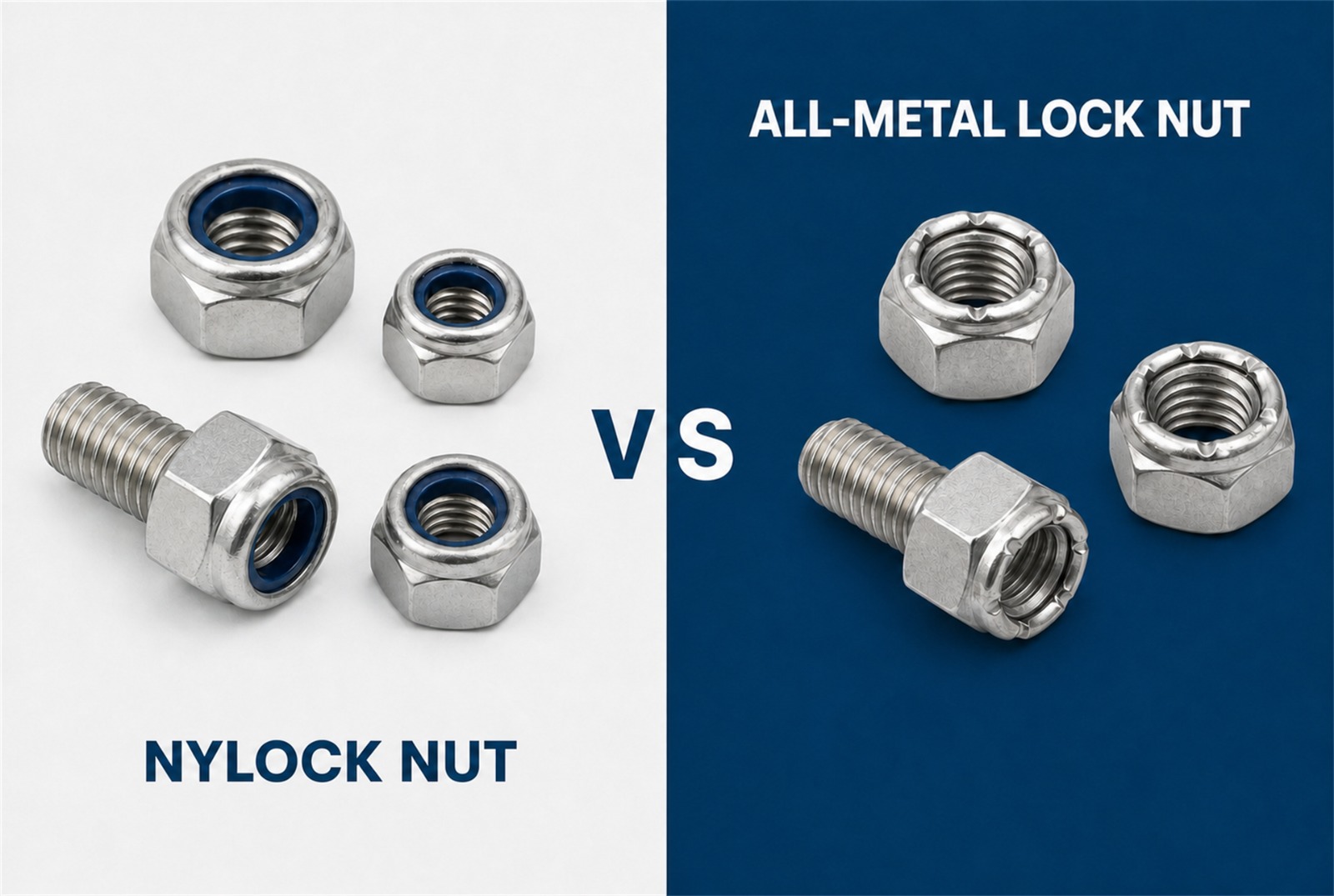
Nylock nuts or nylon insert lock nuts have a nylon ring at the top of the nut. As the bolt thread travels through the nut it contacts the nylon insert. The nylon increases the friction on the bolt threads, which helps prevent loosening from vibration or movement.
The fundamental benefit of Nylock nuts is that they are simple, effective and easy to purchase. No extra locking washers or difficult installation procedures are required. They are used often in applications requiring medium vibration resistance.
Nylock nuts are utilised in automobile parts, machinery, equipment assembly, furniture, electrical enclosures, appliances, and general industrial applications. They are particularly beneficial when the assembly does not have to stand extremely high temperatures.
What is a Metal Lock Nut?
All-metal nuts are locking nuts constructed entirely of metal, without a nylon insert. They develop locking action by controlled thread distortion , distorted top threads or unique nut design . On a bolt, the deformed threads grasp the bolt more securely than a conventional nut.
All-metal lock nuts are often used in heavy machinery, automobile engine areas, construction equipment, railroads, structural assembly, industrial equipment and applications requiring robust locking performance under severe circumstances.
Difference Between Nylock Nuts and All-Metal Nuts
The fundamental difference between Nylock nuts and all-metal nuts is the way they lock. Nylock nuts include a nylon insert that creates friction and prevents loosening. All-metal nuts are designed to grasp the bolt via metal thread deformation or a specific locking feature.
This variation has implications on temperature resistance, reusability, installation torque, cost and application compatibility. Nylock nuts are user-friendly and inexpensive, however the temperature resistance of the nylon insert is limited. All-metal nuts may tolerate greater temperatures and more severe conditions but may need higher installation torque and might be more difficult to remove.
They are both helpful but should not be considered the same thing. The choice of superior locking nut depends on the application situation.
Vibration Resistance
The basic function of locking nuts is to prevent loosening from vibration. Machinery, cars, motors, pumps, compressors, HVAC systems and other moving equipment may generate a constant vibration. Over time, this vibration may loosen a normal nut and decrease clamping power.
Nylock nuts may provide excellent vibration resistance in many general purpose applications. The nylon insert grabs the threads of the bolt and generates friction to assist keep the nut in place.
All-metal nuts also perform well in resisting vibration, particularly for heavy-duty applications. They are generally favoured when the assembly is subjected to repetitive shock, strong vibration or significant operational stress since their locking action is produced by metal-to-metal contact.
Generally nylock nuts are adequate for mild vibration. Severe vibration and hard industrial usage may be best served by all-metal nuts.
Heat Resistance
Among the most crucial variables for selecting between Nylock nuts and all-metal nuts is temperature. Nylock nuts have a nylon insert . Nylon has a temperature restriction . If the assembly is subjected to extreme heat, the insert may become mushy, deformed or lose its ability to lock.
As a result, Nylock nuts are not suited for use in engine compartments, exhaust systems, furnaces, or high temperature machinery or equipment that is exposed to heat during service.
All-metal nuts are superior for high-temperature situations as they contain no nylon. All of them are metal and, depending on the type and the coating employed, they may withstand greater temperatures. Where heat is a critical consideration in the application, all-metal lock nuts are typically the recommended kind.
Re-usable
Another major distinction is reusability. Nylock nuts may be reused in certain non-critical applications, but repetitive installation and removal may degrade their locking ability. The nylon insert wears off after many passes of the bolt threads through it. Once the insert loses its hold the nut may no longer lock reliably.
Repeated usage may also cause some loss of locking strength in all-metal nuts, depending on design and condition of the threads. However they are often better suited than Nylock nuts for situations involving heat or severe service conditions.
Lock nut re-use in safety-critical assemblies should be avoided unless specified by the manufacturer or engineering standard. In many industrial applications , locking nuts are considered replacement items during maintenance .
Installation & Torque
Nylock nuts are often simpler to put on than all-metal lock nuts. The nylon insert only provides resistance after the bolt reaches the insert location. Depending upon the application they can usually be installed using standard hand or power equipment.
All-metal nuts rely on metal thread interference for locking action and may need greater installation torque. This may make installation somewhat difficult. In certain circumstances you need the right tools and careful tightening to prevent damage to the threads or inappropriate clamping.
Whichever kind is used, it is vital to examine whether the torque values should include the extra locking torque. For sensitive applications, the installation should be performed to the prescribed torque specification rather than by eye.
Material & Coating Options
We provide all-metal nuts and Nylock nuts in a wide variety of materials and finishes. Mild steel, high tensile steel, stainless and alloy steel are the most common materials. Coatings may be zinc plating, hot dip galvanising, black oxide, phosphate coating or other finishes.
Locking nuts are frequently supplied by fastener manufacturers in various sizes, grades and finishes to meet bolt and application requirements.
Typical Applications of Nylock Nuts
Nylock nuts are often employed in places where vibration resistance is needed but the temperature is not excessively high. Suitable for general machinery, furniture, electrical panels, appliances, automobile interiors, light fabrication and equipment assembly.
They are also suitable when ease of installation and economy are critical. Nylock nuts offer a sensible compromise between cost and locking performance for many general-purpose assemblies.
They should not be utilised, however, in situations where the nylon insert will be subjected to extreme heat, harsh chemicals or circumstances that will destroy the insert.
Typical Applications of All-Metal Nuts
All-metal nuts are often utilised in heavy-duty and high-temperature applications. They are perfect for automobile engine applications, industrial machinery, construction equipment, railroad applications, structural assembly, agricultural machinery and high vibration systems.
They are also chosen when nylon inserts are not acceptable because of heat or chemical exposure. All metal nuts are commonly utilised for situations where durability and locking strength are more critical than simplicity of installation.
For essential applications, the purchaser should verify nut quality, thread type, coating and compatibility with the bolt before use.
Which Locking Nut to Choose?
Choose Nylock nuts for moderate vibration, normal temperature, ease of installation and general usage. They are inexpensive, easily obtained and applicable to a great number of industrial and commercial assemblies.
If the application includes high temperature, strong vibration, shock load, harsh circumstances or safety-critical fastening, use all-metal nuts.
Summary
Both Nylock nuts and all-metal lock nuts are intended to minimise loosening and increase the durability of the joint. Nylock Nuts use a nylon insert to lock onto the bolt thread, making them suited for mild vibration and general purpose applications. For high temperatures, strong vibration and rigorous industrial circumstances, all-metal nuts are better equipped, since they employ metal thread deformation or a specific locking design.
The proper locking nut should be chosen based on the vibration level, temperature, load, environment, reusability, material and the way it is installed. Incorrect locking nut choice may lead to loosening, lower clamping force or premature failure.
Fastener World (India) can assist you in choosing the correct nut type, size, grade and finish according to your application for bulk needs of Nylock nuts, all metal nuts, hex nuts, flange nuts, high tensile nuts and other industrial fasteners.