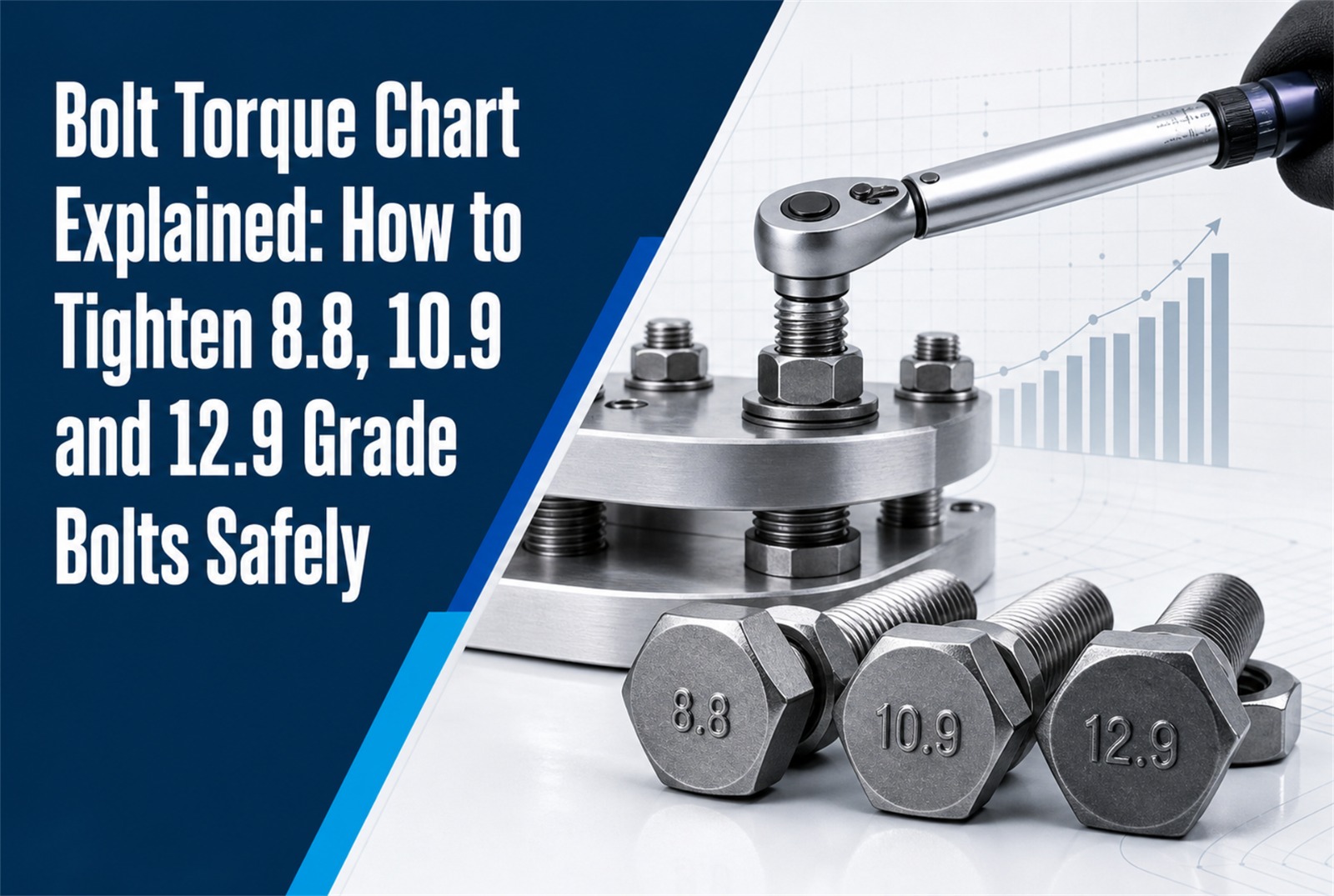
Bolt Torque Chart Explained: How to Tighten 8.8, 10.9 and 12.9 Grade Bolts Safely
Introduction
Bolts are used in machinery, fabrication, building, automotive, equipment assembly and many more industrial uses. But selecting the appropriate quality of bolt is just one step of establishing a robust junction. The bolt must also be properly tightened to the correct torque. If the bolt is too loose, the joint may slide, vibrate or fail. If the bolt is over tightened the threads may peel, the bolt may flex or the material being bonded harmed.
This is where a bolt torque chart may help. A torque chart is a handy tool for users to determine the amount of tightening force to apply on a bolt depending on size, grade, condition of threads and application. Common industrial fastening high tensile grades of bolts are 8.8, 10.9 and 12.9 and each grade may need a different tightening force.
Manufacturers, maintenance teams, engineers and procurement teams may use the knowledge of torque levels to increase safety, joint reliability and service life.
What Is Torque On A Bolt?
Bolt torque is the rotational force exerted when a bolt or nut is tightened. It is normally fitted with a torque wrench. The tightening is done to provide clamping force between the linked pieces. This clamping force stops the assembly from moving and keeps it together.
Torque is frequently measured in Newton metres (Nm). In certain circumstances, it may be expressed in kgf-m or lb-ft depending on the standard being followed.
Torque is not bolt strength, and you need to know that. Torque is the tightening force that is applied during installation.
What is a Bolt Torque Specification?
A bolt torque chart is a reference chart that provides the recommended torque values for tightening bolts of various sizes and grades. It allows users to determine a safe tightening range rather than having to guess during the installation.
A common torque specification chart may include bolt diameter, thread pitch, grade, dry torque value and lubricated torque value. For example, an M10 bolt of grade 8.8 may have a different suggested torque than an M10 bolt of grade 10.9 or 12.9.
Torque charts are particularly helpful for high tensile bolts used in machinery, equipment, automotive assembly, building projects and maintenance operations. However, these should be used as a guide. For important applications, always refer to the equipment manufacturer’s specification or engineering design requirement.
8.8 Grade Bolt Torque: What is
Grade 8.8 high tensile bolts are commonly utilised. They provide an excellent compromise between strength, availability and affordability. These bolts are utilised in a wide range of applications in machinery, general fabrication, automotive parts, structural brackets and industrial equipment.
The torque number for tightening grade 8.8 bolts must be chosen according to the size of the bolt and the pitch of the thread. A bigger diameter bolt requires more torque . This is because bigger bolts may provide more clamping force . Smaller bolts need less torque to prevent thread damage or breakage.
Grade 8.8 bolts are acceptable for many common industrial applications, but should still be tightened using a torque wrench when joint dependability is critical.
Understanding Grade 10.9 Bolt Torque
Grade 10.9 bolts are stronger than grade 8.8 bolts. They are employed in more heavy duty situations where stronger clamping and greater load capacity are needed. Typical usage includes automobile assembly, heavy equipment, industrial machines and high stress joints.
Grade 10.9 bolts are stronger, and hence the suggested torque values for them are often greater than grade 8.8 bolts of the same size. But it does not imply they should be tightened without restraint. However, too much torque might harm the bolt or the assembly.
Also, it is crucial to utilise suitable nuts and washers when employing grade 10.9 bolts. A strong bolt used with a weak nut might shred threads or induce joint failure.
Understanding Grade 12.9 Bolt Torque
Grade 12.9 bolts are exceptionally high strength fasteners used for demanding applications. They are widely employed in die and mould equipment, heavy machinery, precision assembly, automotive performance parts and high load mechanical joints.
Grade 12.9 bolts are very strong and may need greater torque values than 8.8 and 10.9 bolts. But they also need cautious installation. Tighten these bolts using the appropriate tools and adequate torque standards.
Using the improper torque on a grade 12.9 bolt may be dangerous in crucial applications. If it is too loose it may become loose and if it is too tight the threads may be damaged or the bolt may fail. For these applications always follow the appropriate torque specification table or manufacturer recommendations.
A key thing to look for in any bolt torque chart is the variation between dry and lubricated torque. Dry bolts do not have any lubrication on the threads. A lubricated bolt may contain oil, grease, anti-seize compound or a coating which lowers friction.
Factors Affecting Torque Values
There are various elements affecting the torque values. One of the main issues is the bolt size. Larger bolts usually need more torque. Bolt grade also affects the required torque. Higher strength bolts can take more preload.
The thread pitch will determine how much the bolt stretches and clamps the joint. Coating and lubrication influence friction. Zinc plating, hot dip galvanising, black oxide, oil, grease and anti-seize chemicals may all influence tightening behaviour.
It is also vital what material will be clamped. Aluminium, plastic, wood or soft material is not to be compared with a hard steel joint. Too much force might compress the surface or degrade the durability of the joint in soft materials.
Basic Torque Safety Guidelines
Use nuts and washers that match. A high tensile bolt must be used with an appropriate fastener of equivalent strength. Also verify whether the torque measurement is for dry or lubricated threads.
When two or more bolts are used, tighten in the proper order, particularly in flanges, covers, base plates or machine assembly. Tighten slowly to spread the weight evenly.
When to Use a Torque Chart
If joint strength, safety or dependability are required, utilise a torque specification chart. Useful in machinery installation, equipment maintenance, automobile assembly, structural construction, flange connectors and high duty fastening.
Standard torque recommendations may be sufficient for most non-critical applications. Always follow the original equipment manufacturer’s instructions or technical specs for important applications.
Fastener suppliers may explain the bolt grades, sizes, coatings and standards to purchasers, but when it comes to the application and joint design, the ultimate torque must be considered.
Conclusion
A bolt torque chart enables the user to tighten bolts safely and reliably. It offers suggested torque values by bolt size, grade, and thread condition. Using the correct torque chart helps ensure safe installation, proper preload and long-term joint reliability.
Fastener World (India) will enable you to pick the proper size, grade, coating and standard as per your application for bulk needs of 8.8, 10.9 and 12.9 grade bolts, nuts, washers, socket head bolts and other industrial fasteners.