How to Choose the Right Washer: Plain, Spring, Star and Machined Washers Explained
Introduction
Washers are tiny pieces, yet they influence the operation of practically every bolted joint. A washer may distribute load, protect the surface, assist in locking, enhance alignment and help the fastener seat properly. The improper washer choice in industrial applications might result in surface damage, loosening, uneven tightening or premature joint failure.
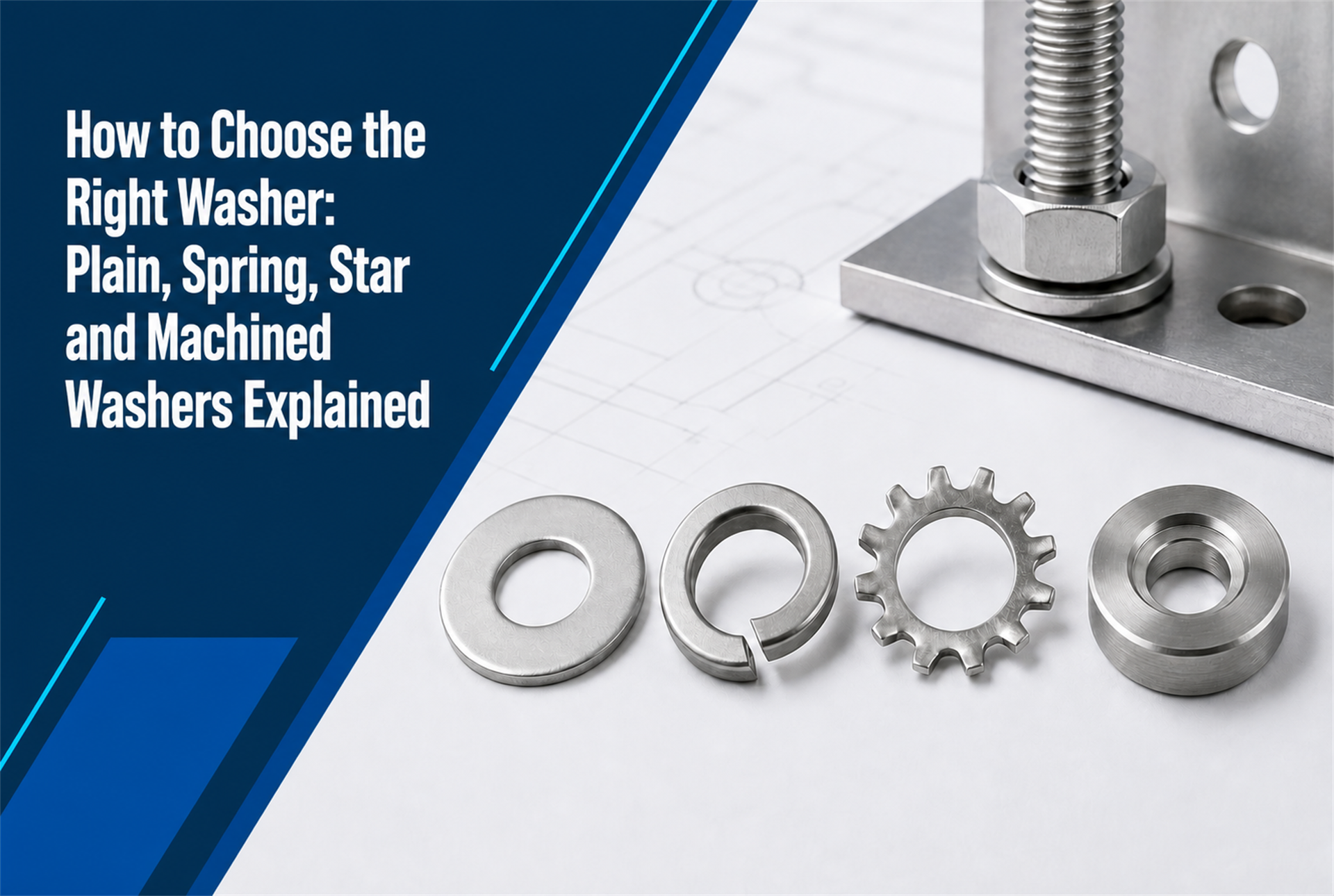
A plain washer, spring washer, star washer and machined washer might all be used with bolts, screws or nuts, but they are not designed for the same purpose. Buyers, engineers and maintenance teams may use these distinctions to help them pick the proper industrial washers for machinery, fabrication, electrical equipment, automobile assembly and structural work.
What Is a Washer?
The function of a washer is to spread load across a larger area. This relieves the surface and helps avoid damage while tightening it. washers may also be used as spacers, locking members, wear surfaces or alignment supports.
Industrial washers may be supplied in mild steel, stainless steel, brass, copper, nylon and high tensile steel and with finishes such as zinc plating, hot dip galvanizing, black oxide or other corrosion resistant coatings.
Washer, Flat
The most common washer is a plain washer. The top is flat and it is mostly for distributing the load. Plain washers distribute the load of the bolt or nut across a wider surface area when a bolt or nut is tightened.
Flat washers are handy when the material to be joined is softer than the fastener. They are often used on sheet metal, aluminum, plastic, wood, painted surfaces and light fabrication work. If a washer is not used the nut or bolt head might gouge into the surface and cause damage.
If the hole is a little bigger than the fastener diameter, a basic washer will also work. It provides support around the hole and gives the fastener better seating. But a plain washer is NOT a locking washer. If the application is subject to vibration or repetitive loads, another locking technique may be necessary.
Spring Washers
Spring washer resists loosening. It is frequently cut at one spot and given a tiny twist, so that it has a spring-like movement. As the nut or bolt head is tightened, it pulls the joint together.
Spring washers are used often in equipment, motors, pumps, maintenance operations and mild to medium vibration applications. The spring washer maintains pressure during little movement or settling of the joint.
But spring washers should not be used as a cure-all for every vibration issue. In strong vibration, impact or essential safety situations, they may not be able to offer sufficient locking performance on their own. More appropriate would be lock nuts, thread locking chemicals, serrated washers or design locking solutions.
Star Washers
A star washer has teeth on the inside or outside edge . These teeth bite into the mating surface and the fastener to assist prevent rotation. Star washers are typically utilized when there is a need for electrical contact or anti-loosening support.
External tooth star washers feature teeth on the outer diameter and give biting action over a larger region. Internal toothed star washers contain teeth around the hole . These are typically used when the washer has to go under tiny fastener heads .
Star washers are widely used in electrical panels, control cabinets, appliances, instrumentation and light mechanical assembly. The teeth may assist break up surface layers or coatings to improve electrical grounding in specific situations.
Star washers bite into the surface and may leave scars. They are not appropriate if attractiveness, paint protection or corrosion resistance are a requirement. Damage to the coating might also cause corrosion surrounding the contact region.
Machined Washer
A machined washer will have tighter dimensional control and be smoother finished than a normal stamped washer. It is employed when precision, flatness and uniformity of thickness are required.
Machined washers are used in heavy machinery, precision equipment, tool rooms, dies, molds, structural assembly and high-load applications. They seat better and distribute loads more evenly than rough or uneven washers.
For situations where alignment is critical, a machined washer may provide a firm bearing surface beneath the fastener. This is important when the joint is subjected to a high stress or when uneven tightening might influence the functioning of the machine.
Machined washers tend to cost more than ordinary washers but they are more consistent. The extra expense is sometimes justified by increased dependability for mission important equipment.
Choice of Materials and Coatings
When choosing a washer, you need to think about kind and material. Mild steel washers are excellent for a wide range of indoor and general use applications. Stainless Steel washers are suitable for outdoor, chemical, marine, food processing and corrosion prone situations.
Coating is important too. Zinc plated washers are used for simple corrosion prevention in indoor and moderate exposure situations. Hot dip galvanized washers are best for outdoor constructions, heavy fabrication and wet conditions. Normally stainless steel washers are used with stainless steel fasteners to prevent a mismatch of materials.
Choosing a Washer
First determine the function of the washer. If the need is load distribution and surface protection, then a plain washer is generally enough. A spring washer may be considered where additional resistance to loosening is needed. If biting action or electrical contact is needed a star washer may be beneficial. A machined washer is preferable for applications that need precision, flatness and strong load support.
Also need to verify the application environment. Outdoor, coastal locations require improved corrosion resistance. Chemical or wash-down areas In high temperature locations, appropriate metal washers may be used instead of polymer washers.
The size of the washer must match the fastener diameter, hole size and bearing surface. If too small it may not distribute the load effectively and if too large the washer may interfere with other components. Proper torque, alignment and clean mating surfaces are also required.
Summary
Although washers are little components, they have a direct impact on the efficacy of the fastening. washers, when properly chosen, protect surfaces, distribute loads, aid in locking, enhance electrical contact or give a perfect bearing surface.
For general load distribution a plain washer is appropriate. Spring washer for mild anti-loosening treatment. Star washer is beneficial for biting action and electrical assemblies. If you want accuracy and heavy loads, a machined washer should be used.
When buying for industrial washers, purchasers should check on the washer type, size, material, coating, hardness, application load and operating environment. Fastener World (India) can provide plain washer, spring washer, machined washer and other industrial washers as per application demands and project standards.