Socket Head Cap Screws vs Hex Bolts: Which Fastener Should You Use?
Introduction
Socket head cap screws and hex bolts are common industrial fasteners used in equipment, fabrication, automotive, construction, assembly and maintenance activities. Both make for strong joints, but they vary in design, how they are installed and what they are most suited to.
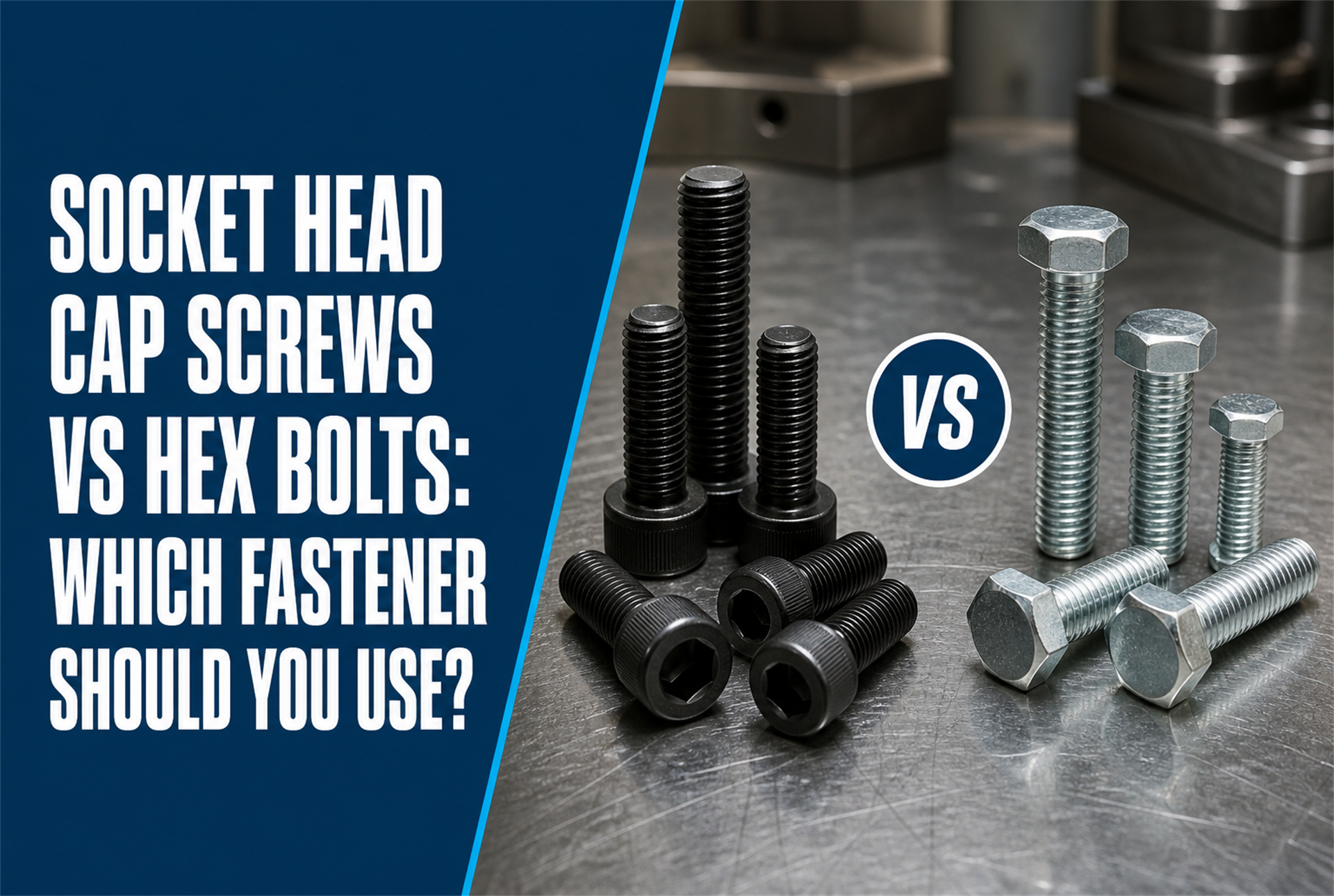
A socket head cap screw is a screw with a cylindrical head containing an internal hex socket drive, which is tightened with an Allen key or hex bit. A hex bolt is a bolt with a hexagonal exterior head, and is tightened using a spanner, socket or wrench.
Socket head cap screws are a kind of screw characterized by their cylindrical head and internal hex socket drive. Socket head cap screws need a specific tool to access the internal drive, ensuring a secure and precise fit.
Socket head cap screws are cylinder headed fasteners with an internal hex drive. Because the drive is within the head, the exterior is still circular and small.
Socket head cap screws are widely utilized in machinery, dies, molds, automation equipment, tools, engines, precision assembly and applications where space is at a premium. They have a small head profile that allows them to be used in counterbored holes.
These screws are commonly used when great strength, a clean look and controlled tightening are needed. They are available in a range of materials, grades, diameters, thread types and coatings.
What Is A Hex Bolt?
Hex bolts are fasteners with external threads and a hexagonal head. They are normally mounted with a nut or into a tapped hole, then tightened with a wrench, spanner or socket . Hex bolts are among the most utilized fasteners in industrial and structural applications.
Hex bolts find extensive application in building, fabrication, machinery, automobile assembly, equipment frames, brackets and general maintenance. Designed with a head that can be easily gripped with ordinary tools even in heavy-duty situations.
Hex bolts are available in full thread and half thread as per the demand. Mild steel, high tensile steel, alloy steel, stainless steel are the materials available and treatments such as zinc coating, hot dip galvanizing and black oxide are available.
Socket Head Cap Screw vs Hex Bolt – What’s the Difference?
Socket head cap screws vs. hex bolts The fundamental difference between a hex bolt and a socket head cap screw is the head and the driving design. Socket head cap screws have an internal hex drive, whereas hex bolts have external hexagonal head.
Socket head cap screws are used in applications where space is restricted, appearance is important, or the fastener must be seated in a counterbore. A hex bolt is the best choice when there is simple access for an outside tool and when the assembly requires a useful, general-purpose fastener.
The other distinction is the installation style. Socket head cap screws are often utilized in precision assemblies and tapped holes. Hex bolts are often utilized with nuts, washers and structural connections.
Performance & Strength
Good fastening may be achieved with either socket head cap screws or hex bolts if they are chosen properly. Strength varies by grade, material, diameter, thread engagement and installation technique.
Socket head cap screws are commonly available in high strength grades and are utilized when a compact design and great clamping power are needed. Suitable for machine parts, tool assemblies and high-load equipment when head clearance is limited.
Hex bolts are also available in strength grades 4.6, 8.8, 10.9 and 12.9. Heavy-duty equipment and construction and structural applications require hex bolts of high tensile strength. And the proper grade must constantly be matched to the load and service situation.
Room and access
Space is a key selection consideration. Socket head cap screws are helpful when there is no place for a spanner or wrench around the head of the fastener. They are tightened from the top with an Allen key so that they may be put in tight locations.
Hex bolts require room on the sides for a wrench, spanner or socket. This makes installation simpler in wide spaces but less practical in confined or recessed situations.
Socket head cap screws are often used when the fastener must fit into a counterbored hole or stay below the surface. If the fastener is easy to reach from the sides , hex bolts could be more practical .
Appearance and Installation
Socket head cap screws usually seem cleaner. When fitted in a counterbore, the head may be flush with the component. This is an advantage in equipment, tooling and precision assembly where look and compactness are important.
Socket head cap screws are driven using Allen keys, hex bits or socket tools. The internal drive must be clean and undamaged so it may be properly tightened. The socket might become rounded and difficult to remove if the tool is poorly fitted or over-tightened.
Hex bolts are easy to install and remove using ordinary tools. The exterior head gives an excellent grip making them appropriate for outdoor work, maintenance projects and building sites. The head is still visible so it’s good for inspection and maintenance.
Material and Coating Choices
Socket Head Cap Screws and Hex Bolts are available in mild steel, high tensile steel, alloy steel and stainless steel . Material selection should be based on strength, corrosion resistance, temperature and environment.
Alloy steel socket head cap screws are prevalent in equipment and tools because of their great strength. Stainless steel choices are chosen when corrosion resistance is required. Zinc coated hex bolts are good for mild situations. Hot dip galvanized hex bolts are ideal for outdoor usage and stainless steel hex bolts are ideal for moisture or chemical exposure.
Typical Applications
Socket head cap screws are widely utilized in machinery, molds, dies, engines, automation systems, robotics, precision equipment, fixtures and compact assemblies. They are recommended when strength, sleek design and limited space are required.
Hex bolts are widely utilized in building, steel constructions, fabrication, equipment frames, brackets, automotive parts and general maintenance.
Which Fastener Should You Use?
Socket head cap screws are ideal for applications requiring a crisp finish, limited space, counterbored holes or strong clamping in a compact form. They are suited for precision machinery, tooling and equipment assembly.
Pick hex bolts for a fastener that’s straightforward to install and readily accessible for general purpose use. They are better for building, fabrication, structural joints and maintenance work when there is access for an external tool.
Buyers should check diameter, length, thread type, grade, coating, compatibility with nut or tapped hole and load required before choosing any choice.
Conclusion
Socket head cap screws and hex bolts are both solid industrial fasteners, but they’re designed for distinct uses. Socket head cap screws provide for a small design, clean look and robust fastening in tight locations. Hex bolts are straightforward to install, commonly available and perform well in typical industrial and structural applications.
The proper decision relies on space, load, look, tooling, material, coating and installation technique. Fastener World (India) provides the proper size, quality and finish for your application for bulk needs of socket head cap screws, hex bolts, nuts, washers and other industrial fasteners.