Threaded Rods vs Stud Bolts: Differences, Uses and Selection Guide
Introduction
Threaded rods and stud bolts are very frequent items used in construction, equipment, fabrication, electrical installation, piping systems and industrial maintenance. Both are cylindrical external thread fasteners and while they may seem identical they are not necessarily utilized in the same manner. Wrong choice may impact joint strength, alignment, speed of installation and long-term dependability.
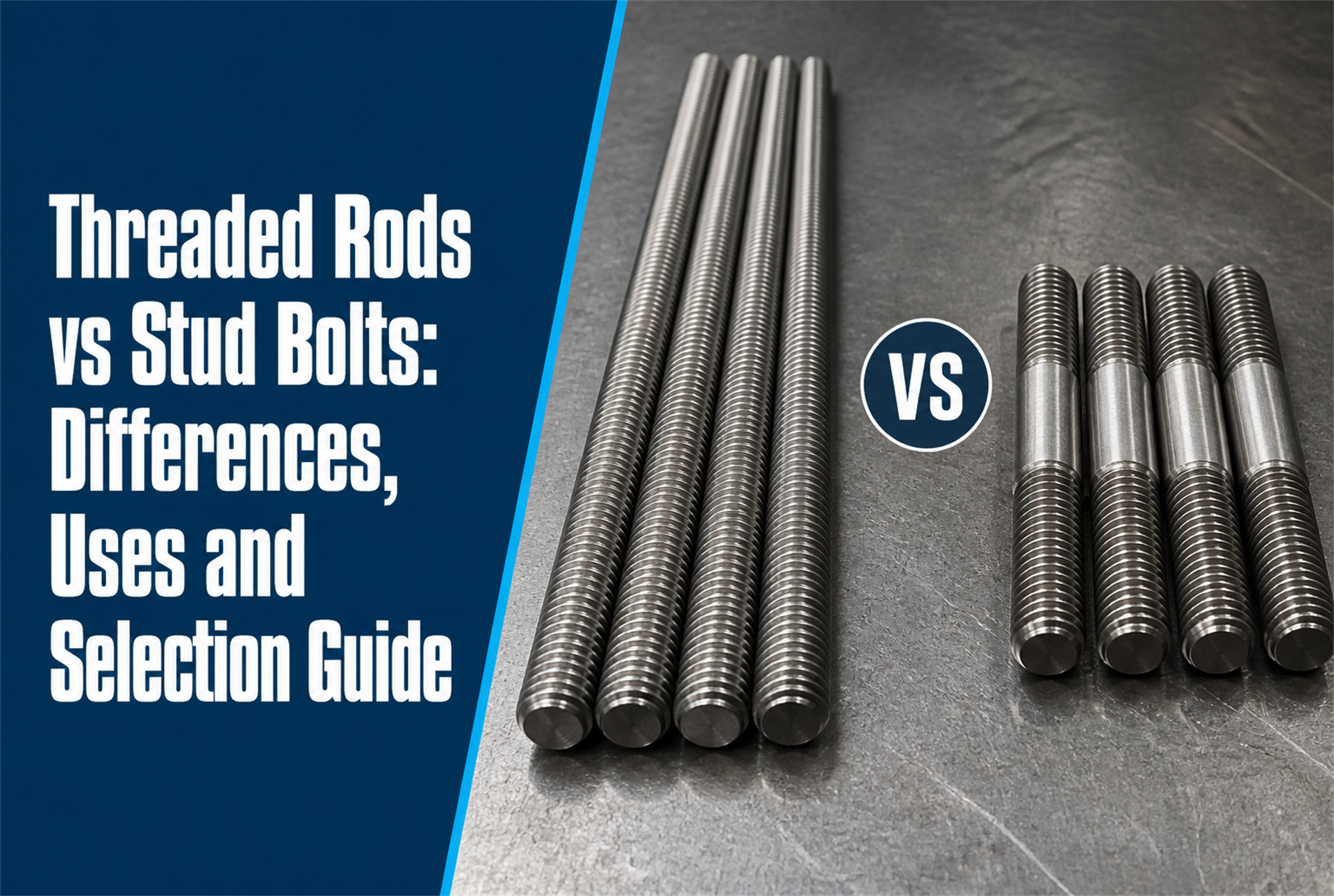
A threaded rod is generally a lengthy rod having threads throughout the whole length of the rod. Stud bolts are usually headless fasteners having threads on both ends . They are often used with nuts on both ends . Getting it right is important to engineers, contractors and procurement teams.
What are Threaded Rods?
Threaded rods are straight metal rods that include threads the whole length. Also known as all thread rods or completely threaded rods. As they are threaded over their whole length they may be shortened to the size necessary and utilized with nuts, washers, plates, brackets or anchors.
Threaded rods are good for when you need an adjustable fastening length. They are often used for supporting pipes, HVAC ductwork, cable trays, electrical supports, ceiling systems, equipment mounts and construction fittings.
The main benefit of a threaded rod is flexibility. The thread is continuous so the nuts may be placed at various positions along the rod. Suitable for applications that need adjustability, spacing or support.
What Are Stud Bolts?
Stud bolts are headless threaded fasteners with no head externally. They are commonly threaded at both ends and used with nuts. Sometimes the whole stud is threaded . But often stud bolts are used for more particular joint needs than typical threaded rods .
Stud bolts are extensively utilized in flanges, pipe systems, pressure equipment, machinery, pumps, valves, engines and structural assemblies. They are particularly frequent when a significant clamping force is needed between two parts.
Stud bolts are bolts without a head unlike conventional bolts. This permits tightening nuts from one or both sides. In flange joints, the stud bolts are put through the matched holes and the nuts are tightened to provide consistent clamping pressure.
Main Difference Between Threaded Rods and Stud Bolts
The fundamental distinction between a threaded rod and a stud bolt is the reason each is used. A threaded rod is a flexible fastening, suspension or support component used widely. A stud bolt is used for specified bolted connections where strength, alignment and clamping are crucial.
Threaded rods are normally available in larger lengths and may be trimmed to size as required. Stud bolts are often provided in standard lengths depending upon the design of the connection. Threaded rods are typically utilized for hanging, bracing and support applications while stud bolts are employed on flanges, equipment and heavy-duty assemblies.
In basic words threaded rods are better for adjustable support while stud bolts are better for fixed, load bearing bolted connections.
Load and Strength Requirements
Strength is a key aspect in the selection of stud bolts or threaded rods. Threaded rods may bear load but their performance is dependent on diameter, material grade, thread quality, length and installation technique.
Standard mild steel threaded rods may be used for light to medium load applications. Heavier loads may need high tensile threaded rods or stronger materials.
In applications where joint strength is important, stud bolts are typically employed. In pipelines, pressure vessels, equipment and structural connections, the grade of the stud bolt has to be suitable for the load and service condition. If a low strength stud bolt is used in a high load joint, loosening, leakage or failure might occur.
Material Selection
Threaded rods and stud bolts of mild steel, carbon steel, alloy steel and stainless steel are available. The correct material relies on strength needed, temperature, corrosion exposure, and application environment.
Mild steel is used for general purposes. High tensile steel is utilized when more strength is required. Alloy steel may be used in heavy-duty machinery, pressure equipment and high stress applications.
Stainless steel is used when resistance to corrosion is needed. SS 304 is good for many corrosion resistant applications. SS 316 is excellent for coastal, marine, chemical or high moisture conditions .
Surface Finishing & Coating
Coating protects threaded rods and stud bolts against corrosion Zinc plating is usually utilized for indoor or low exposure applications. It offers minimal protection and a neat finish.
For outdoor constructions, construction sites, pipe supports and other applications exposed to the weather, hot-dip galvanizing is the recommended choice. It offers a thicker zinc coating and improved long-term corrosion resistance than regular zinc plating.
For certain applications, coatings such as black oxide, phosphate, PTFE and others may be employed. Stainless steel or specially coated fasteners may be needed in chemical, marine or food-processing applications.
Common Applications
Common uses of threaded rods include in pipe hanging, HVAC support, cable tray installation, ceiling suspension, electrical supports, construction bracing, anchor extensions and equipment alignment. They may be trimmed to size, therefore are convenient for site work and maintenance.
Stud bolts are widely utilized in flange joints, valves, pumps, pressure systems, engines, heavy equipment and structural assemblies. They are recommended when good clamping and exact joint alignment is needed.
Things to consider during installation
Threaded rods and stud bolts should be installed with appropriate washers and nuts. Good thread engagement is a key to secure fastening. If the nut is not firmly engaged with the threads the joint may loosen or fail under stress.
If the cut is for threaded rods then the cut should be clean so the threads are not damaged. In flange and equipment applications, stud bolts may need to be torqued in the proper order and at the correct torque. Unequal tightening may lead to leaks, misalignment or unequal stress.
Which One Should You Go For?
Threaded rods are ideal if you require customizable length, suspension, bracing, support or general fastening. Ideal for HVAC, electrical, construction and manufacturing applications where flexibility is critical.
For a fixed bolted joint, robust clamping, flange connection or heavy-duty assembly, look to stud bolts. They are better for pipes, pressure equipment, machinery, and applications where joint strength is important.
Buyers should ensure diameter, length, thread pitch, material grade, coating, nut compatibility and load requirement before making a choice.
Conclusion
Threaded rods and stud bolts may seem identical, but they are used for various types of fastening. Threaded rods are flexible, fully threaded fasteners for support, suspension, bracing and adjustable assemblies. Stud bolts are utilized when stronger and more defined couplings are required, particularly in flanges, equipment and pressure systems.
The proper option relies on the application, load, material, coating, fastener supplier, thread requirement and manner of installation. Fastener World (India) can aid purchasers in selecting the correct size, material, quality and finish for their specific application for bulk needs of threaded rods, stud bolts, nuts, washers, and other industrial fasteners.