How to Choose Fasteners for Food Processing Equipment
Introduction
The food processing equipment is used in harsh industrial conditions. Fasteners for mixers, conveyors, filling machines, packing lines as well as the storage tanks routinely endure moisture, cleaning agents, vibration, temperature fluctuations and also continuous wear and tear. A tiny fastener failure may impair hygiene, safety, manufacturing quality and machine uptime.
Fasteners that are employed in the food processing facilities are typically not only chosen based entirely on their strength. Aside from strength, they must also be corrosion-resistant, contamination-free, simple to clean and fulfill necessary hygiene demands. Before making an order, buyers need to understand the proper material, finish, design and installation processes.
The appropriate standards are important for firms sourcing fasteners manufacturers in India or a regular fastener supplier to prevent corrosion, loosening, contamination and repetitive maintenance concerns.
Why Fastener Selection is Important
Food processing equipment is often exposed to water, steam, oils, salts, acids, cleaning agents and sanitizing chemicals. Regular fasteners may easily be destroyed under these circumstances. Corrosion of the fastener may contaminate the product with rust or may impair the connection.
Food processing equipment undergoes repeated cleaning cycles, which increases the importance of needing corrosion resistance and hygienic design in the fasteners. Poorly selected fasteners may trap moisture or residue and create areas that make it extremely difficult to clean.
Food Processing Fasteners: The Best Materials
The most popular material for the food processing fasteners is stainless steel. It has high corrosion resistance, attractive look and a long service life. SS 316 fasteners with molybdenum offer higher corrosion resistance. This makes them suited for more demanding situations such as seafood processing, dairy facilities, chemical wash down regions, salty conditions and applications exposed to acidic materials.
Mild steel or zinc plated fasteners may be cheaper, but are often not recommended for direct or high moisture food processing areas. They are more prone to corrosion and provide hygienic issues. Suitable grades of stainless steel are commonly preferred for food-contact areas and regions near food-contact surfaces, but material grade, surface finish, cleanability and applicable hygiene requirements should also be considered
Popular Fasteners for Food Equipment
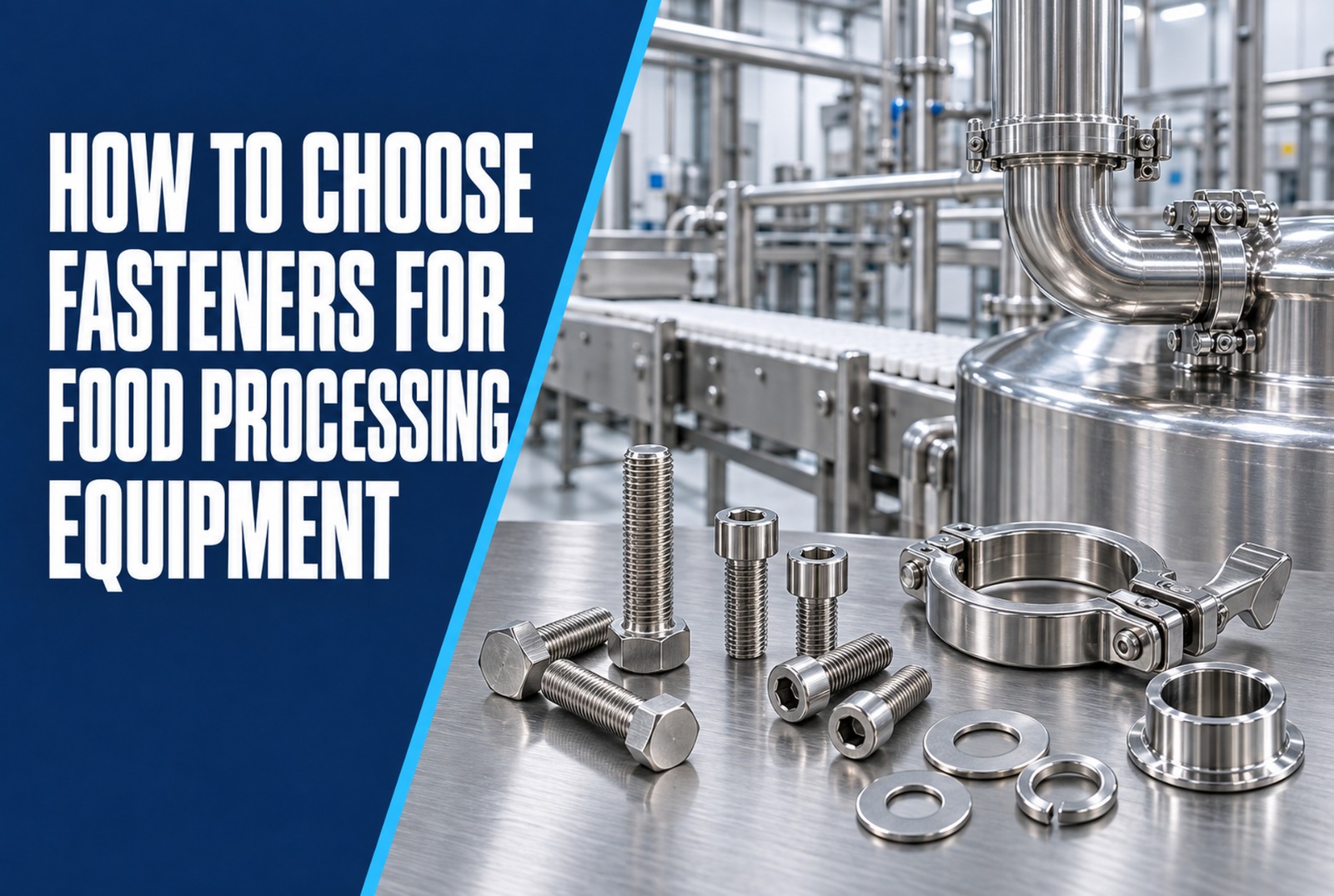
Different kinds of food processing equipment need different types of fasteners. Hex bolts and nuts are typical components of structural frames, machine bases and support systems. Socket head cap screws are used when a compact design and greater strength is desired.
MACHINE SCREWS For use in panels, coverings, guards and electrical housings. Washers. Surface protection and load distribution while tightening. Rivet nuts are helpful in sheet metal panels when access is allowed only from one side. Self-clinching fasteners may be utilized in enclosures when a permanent threaded anchoring point is needed.
Careful choice of fasteners is essential for conveyor systems, since they may be stressed by vibration, product load and repetitive cleaning. In equipment that requires frequent maintenance, fasteners should also be easily removable and reassembled without damage to threads.
Surface Finish and Hygiene
Surface finish is vital for food processing equipment. Rough or broken or badly finished fasteners may retain food particles and cleaning residue. Smooth stainless steel fasteners are simpler to clean and maintain.
Avoid sharp edges, burrs and broken threads since they might hurt workers, gather dirt or interfere with tightening fasteners for visible or wash-down surfaces should be of a clean finish and uniform quality.
Stainless steel fasteners that are polished may be used for particular applications because they are easier to clean and they look nicer. The choice relies on whether the fastener is used in a food contact zone, splash zone or non-contact machine region.
Cleaning Chemicals & Corrosion Resistance
Cleaning chemicals are one of the leading contributors of fastener failure in food processing operations. Buyers should also consider the temperature of cleaning cycles, as heat may enhance chemical effect on the fastener surface.
The application environment should be carefully communicated to the fastener provider before ordering. This allows you to pick the proper quality, size and finish of stainless steel not only by pricing.
Avoidance of Loosening in Motion Equipment
Food processing equipment are commonly equipped with motors, gearboxes, rollers, conveyors and vibrating elements. If the joint is not correctly built, these motions might gradually release normal fasteners.
Loosening may be reduced by using suitable locking methods such as lock nuts, all-metal lock nuts, prevailing-torque nuts or thread-locking compounds, depending on the application and service conditions.
And proper tightness is necessary, too. Fasteners that are too loose may come free rapidly, while fasteners that are too tight might strip threads or distort parts. Recommended torque values should be used by maintenance teams if such values exist.
Essentials of a Buying Checklist
Buyers should verify the application area, material grade, fastener type, size, thread, finish, load condition and cleaning exposure before purchasing fasteners for food processing equipment. They also need to examine to see whether the fastener will be exposed to vibration, heat, moisture, salt or chemicals.
Not all fasteners in a food plant are created equal. Fasteners near food contact surfaces need more stringent material and hygiene consideration. Corrosion resistant fasteners should be used for support frames, guards or exterior coverings when exposed to cleaning or moisture, but need not be in contact with food.
Standardization of common fastener sizes on machinery is beneficial. This makes maintenance easier, lowers stock confusion and helps procurement teams handle recurrent purchases better.
Buyers may associate with professional manufacturers of fasteners in India for sourcing appropriate items for ordinary as well as unique applications. A trusted fastener supplier can also assist with material selection, coating recommendations, bulk availability and emergency replacement requirements.
Conclusion
Careful Selection of Fasteners for Food Processing Equipment The correct fastener enhances safety, hygiene, corrosion resistance, machine dependability and simplicity of maintenance.
Stainless steel fasteners are the standard choice for most food processing applications. Use SS 304 for general purposes; use SS 316 for more demanding, chemical or high-moisture situations. Buyers should also look at the surface polish, the way the fastener locks, exposure to cleaning and whether the fastener is used in food contact or non-food contact areas.
Fastener World (India) can help purchasers seeking for stainless steel fasteners, food processing fasteners and industrial fastening solutions, depending on application, grade, finish and quantity needs.