Internal vs External Circlips: Differences, Applications and Selection Guide
Introduction
Circlips are tiny parts that are used to retain machinery assembly. Internal and exterior circlips have a similar holding function, but they are designed for different positions and need distinct installation procedures. Knowing these discrepancies allows engineering, maintenance and procurement teams to buy the right component.
If you are a buyer or procurer of fasteners in India, then this article will help you understand about the many varieties of circlips, their uses and considerations when choosing them.
What Is a Circlip?
A circlip is a retaining ring fitted into a machined groove. When seated it produces a shoulder which restricts the axial mobility of a neighbouring component. Axial movement is movement along a shaft or hole.
Circlips may give a compact form of retention when room is restricted. Many designs also permit removal for service, using the appropriate equipment and procedures. But circlips need a well built groove. Choosing a ring based on size alone may mean it doesn’t sit properly or stay in place.
Internal Circlips
What Do Internal Circlips Do
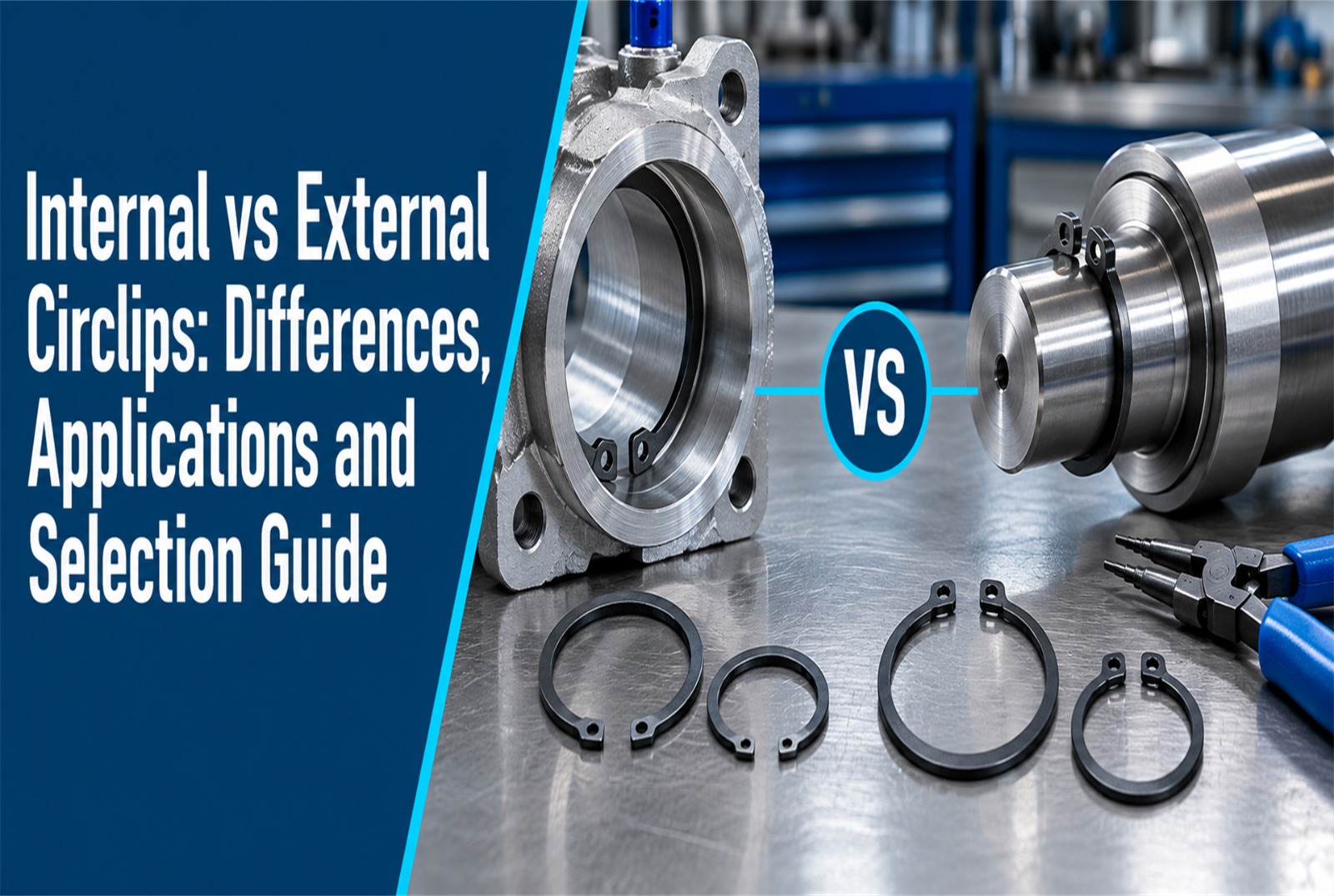
Internal circlips are inserted into grooves cut into a bore or housing. Installation is done by compressing a typical lugged internal circlip using circlip pliers. Once released, it will stretch out into the groove.
The mounted ring protrudes inward from the housing wall and provides a retaining shoulder for the adjoining section.
Typical Uses
Internal circlips are used to keep bearings, bushes along with other components inside gearboxes, pumps, motors as well as equipment housings.
For example, a bearing may be positioned between a housing shoulder and an internal snap ring. The assembly design allows for the axial movement to be controlled. Bore diameter, groove dimensions, operational load and access availability for installation should be considered while selecting.
External Circlips?
How do external circlips work?
External circlips are fitted into grooves cut around the exterior of a shaft. A standard lugged external circlip is expanded with proper pliers and slipped over the shaft to be released into its groove.
This will cause the ring to shrink into position with a part protruding beyond the shaft surface to hold the neighbouring component.
Typical Applications
External circlips are routinely employed on shafts holding gears, bearings, pulleys, washers or any kind of linkage parts. Applications often end up involving machinery, automobile assembly, agricultural equipment and power transmission systems, among other use cases.
For example, an external snap ring may assist in holding a part between a shoulder on a shaft and the ring. Its appropriateness is determined by the whole assembly specification.
Differences Between Internal and External Circlips
Installation Site
Internal circlips retain components inside a bore or housing. External circlips are used to keep parts on a shaft. The style required depends on the position of the groove. Although their nominal sizes are close, they are not interchangeable.
Installation Method
The conventional way is to compress internal circlips for installation and expand external circlips. Using improper pliers or excessive force may distort the ring and compromise on the retaining ability.
Size Recognition
Internal snap rings are usually characterised by the nominal bore diameter. The nominal shaft diameter is usually the way an external circlip is defined.
The installed working diameter and the loose ring diameter vary. Catalogue sizes should be checked by buyers and not measured from an old ring and ordered by that measurement.
Selecting the Right Circlip
Verify Size & Groove Particulars
Begin with the assembly design and the ring specification you need. Check the nominal size, ring thickness, groove diameter, groove breadth and installation clearance.
Check load and service conditions
Circlips are mostly used for axial retention. The selection must consider the axial force, shock, vibration, temperature and the working speed of the rotating assembly. The retention capacity is decided by the ring and groove. A good ring cannot make up for a groove that is overly weak or machined wrongly.
For critical applications, verify the whole arrangement using manufacturer data and engineering calculations.
Choose Right Material and Finish
Circlips are usually made from spring steel since it has the elastic characteristic that is required to insert and hold these circlips in place. In case corrosion resistance is required, then stainless steel solutions can be explored accordingly.
Installation and Inspection Requirements
Before installing, it is important to clean the groove and examine it for any kind of burrs, damage or possible contamination. End users must ensure that the circlip is fully and correctly seated in its designated groove after installation for it to function properly.
Manufacturers are encouraged to follow any alignment directions for the circlips that are supplied. Do not reuse a circlip that is warped, broken, rusted or otherwise unfit for service.
Mistakes To Avoid When Buying
It is a common error to order by diameter alone, without knowing whether the ring is internal or exterior. Mistakes include ignoring thickness, combining metric and imperial diameters, and thinking comparable rings have equivalent load capabilities.
Another reason for repeated trouble is fitting a replacement circlip without checking the groove. The initial failure might be a damaged groove, too much load or faulty installation.
When comparing the fasteners manufacturers in India, provide similar requirements so that quotes are for identical items. Approve supply once material, finish, dimensions, quantity and any inspection paperwork have been confirmed.
Conclusion
Internal and external circlips provide a compact means for holding the parts together in mechanical assemblies. Internal circlips fit really well within housings, whereas external circlips do a good job when it comes to working with shafts. Ultimately, the right choice depends upon the size, groove design, material, load as well as the access for installation of these circlips.
Procurement teams should be using approved drawings along with verified specifications. A trusted supplier of fasteners may assist to clarify product identification and sourcing needs before placing an order.
For circlip sourcing queries, send your needed type, size, material, finish and quantity to Fastener World (India) with necessary design or specification.