Machine Screws Explained: Head Types, Uses & Applications
Introduction
Machine screws are designed to be used with tapped holes or nuts, and they provide clean, repeatable connections in metal components, polymers, and assemblies that need to be maintained over time. Unlike self-tapping screws, machine screws don’t cut their own threads. Instead, they work with holes or nuts that already have threads to provide a strong and accurate fastening solution.
Because of this, machine screws are often preferred in electrical enclosures, equipment housings, machinery panels, automobile parts, and consumer electronics. They are great for assemblies that need to be easy to maintain since you can take them off and put them back on many times without harming the thread.
The head design of a machine screw has a significant effect on how the load is spread out, how the joint appears when it is installed, and what equipment may be used to fix it.
Pan Head Machine Screw
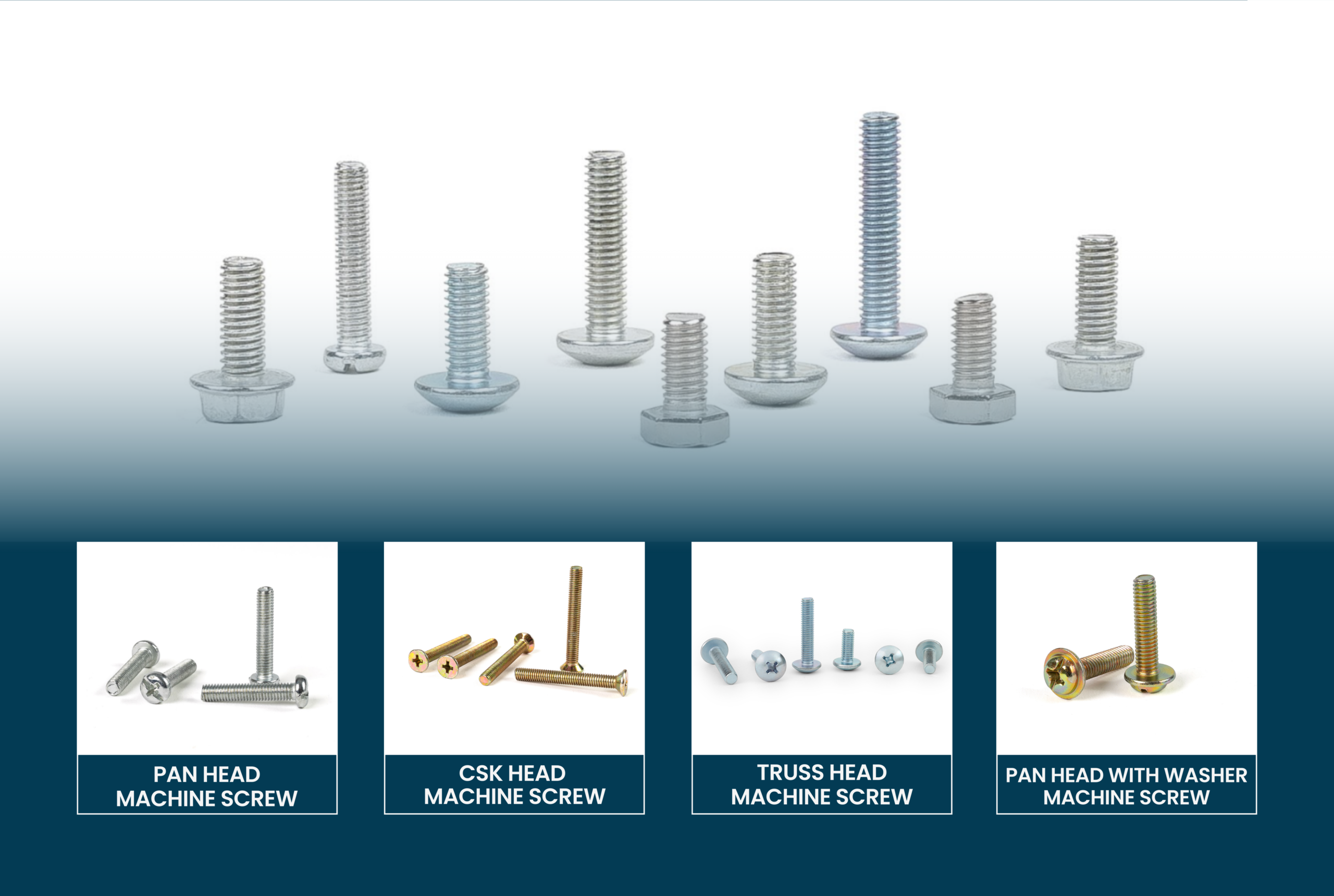
Pan head machine screws are a good option for daily use since they have a rounded, low-profile head and a wide bearing surface. The head rests well on top of the surface and spreads the weight evenly across the material underneath.
Pan head screws are used a lot in electrical panels, control boxes, light fabrication, and equipment housings where a clean look and reliable attaching are needed. This is because their balanced design makes them easy to handle. The bigger head diameter distributes the weight over a broader area, which helps keep thinner materials from breaking.
They are also straightforward to install using Phillips or slotted heads, which are typical types of screwdriver drives. This makes them useful for both production settings and field maintenance work. Pan head machine screws are often seen as the general-purpose choice for many assemblies since they are strong, look good, and are easy to install.
CSK Head Machine Screw
In many applications, it is important for the screw head to sit flush with the surface after installation. CSK screws sit flush with the surface when used with a countersunk hole. The conical head fits into a countersunk hole, allowing the screw to sit flush with the surface.
This style works well when screw heads that stick out could get in the way of pieces moving or rolling. Countersunk screws are often used in panels, doors, cover plates, and stylistic trim because of this.
If you use CSK screws in places where people can see them, like on furniture, equipment, or consumer goods, they not only work better but also look better and more professional.
Pan Head with Washer Machine Screw
In this design, the washer is pre-assembled under the head of the screw, creating a SEMS configuration. This spreads the clamping force and prevents the washer from being lost during installation. Pre-assembled washers also simplify assembly processes and reduce the number of loose components that need to be handled during installation.
You can put together appliances, metal shelves, frames, and light structure parts with these screws depending upon the assembly design.
Truss Head Machine Screw
Compared to regular pan heads, the wider head distributes the load across a larger surface. This makes truss head screws especially good for putting together light things like thin sheet metal.
They are typically utilized in places like signboards, cable trays, metal ducts, and electrical panels where powerful clamping is needed yet there is no danger of pull-through.
The smooth dome shape also makes the installation seem sleek and aesthetic. This makes truss head screws good for visible assemblies where both performance and looks are important.
Flange Phillips Machine Screw
Flange head machine screws have a rim beneath the head that looks like a washer. This built-in flange helps protect the surface and makes the clamp stronger by spreading the weight over a larger area.
The design does away with the requirement for a separate washer, which makes installation easier and cuts down on the amount of parts needed for assembly. In places where speed and uniformity are crucial, flange screws work especially well.
The Phillips drive makes the tools easy to use and lets you install them quickly with regular or powered screwdrivers.
Manufacturers and engineers often utilize flange Phillips screws in automobile trim parts, appliance assembly, and general fabrication work where both ease of usage and weight distribution are important.
Hex Phillips Machine Screw
Hex Phillips machine screws are fasteners that have two ways to drive them. The outside hex head lets you use a spanner or socket for greater torque jobs, while the Phillips recess lets you install it with a screwdriver when you can’t get to it easily.
This dual-drive configuration makes installation and maintenance easier. Depending on the work environment and how easy it is to get there, assemblers may choose the tool that works best for them.
Hex head machine screws are often used in panels, frames, and equipment systems that need to hold things together with more force because they can handle more power.
It’s also easier to service and make quick changes with Phillips recesses, which makes them a good choice for things that need to be maintained often.
Conclusion
It is very important to pick the right type of machine screw head to make sure that systems are strong and work well. How the load is spread out across the material, how the fastener goes on the surface, and what tools can be used to put it in differently depend on the shape of the head. There are different amounts of grip and force for each type of drive, which makes it less likely that something will slip during installation.
Pan heads are useful for ordinary fastening, countersunk heads provide a flush finish, and larger heads like truss or flange designs help distribute the weight better on thinner materials. At the same time, hex head types provide for more torque when a stronger fastening is needed.
We have a lot of different machine screws at Fastener World (India), with different head designs, sizes, and finishes, so you can pick the appropriate one for your project.