Rivet Nuts Explained: Types, Designs, And Applications
Introduction
Rivet nuts are ideal when access to the rear side of a workplace isn’t possible since they provide you with a robust threaded insert from one side. People often utilize them to make sheet metal, tubing, enclosures, and lightweight structural parts that need a strong internal thread.
Unlike traditional nuts that require access to both sides of a joint, rivet nuts are installed into a drilled hole and collapse behind the material to create a strong threaded anchor point.
Large Collar Rivet Nut with Round Splines
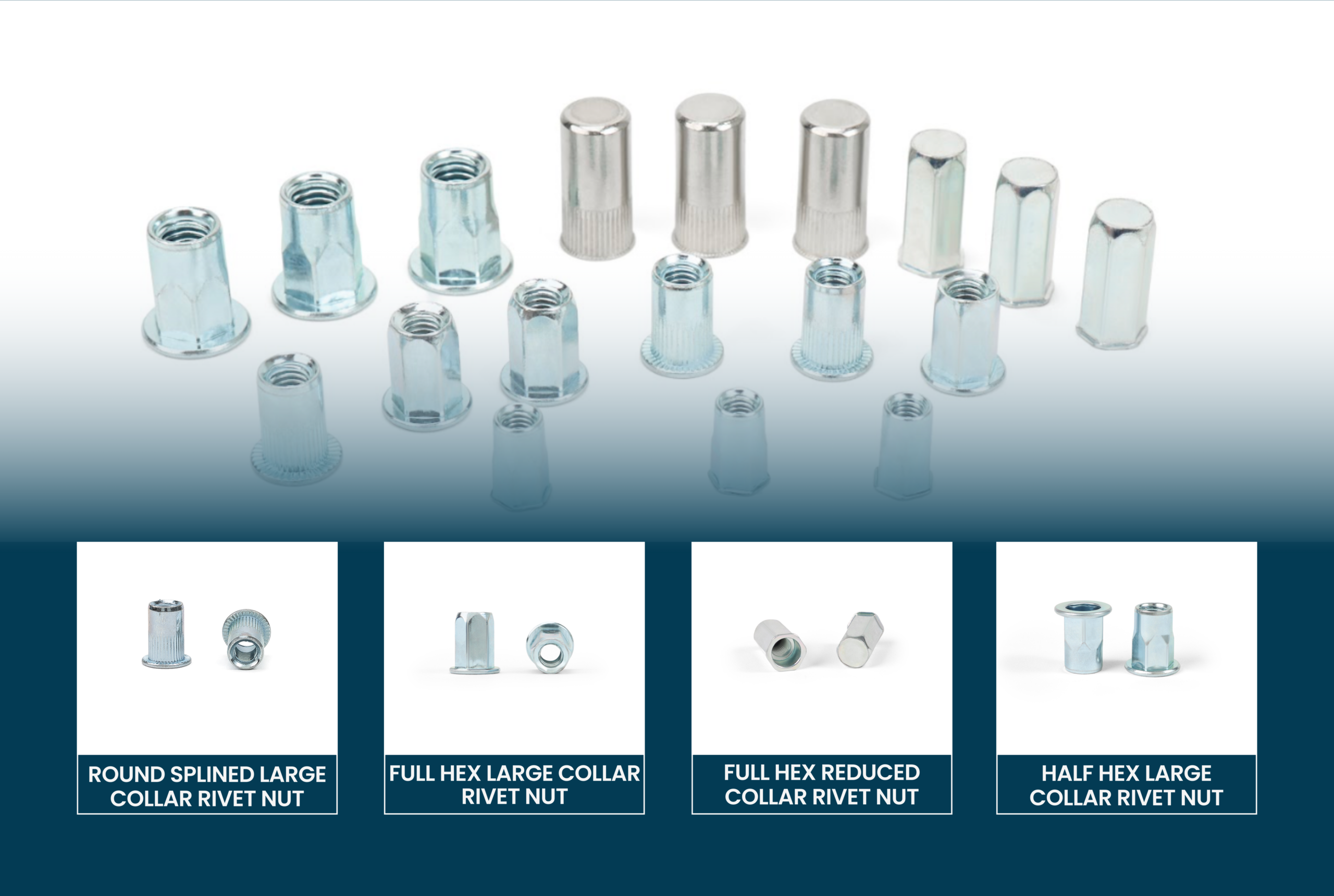
A circular body with vertical splines that dig into the hole to stop it from spinning, and a big collar to disperse the weight. This kind is suitable for softer materials like thin sheet metal, aluminum, and big or slotted holes where more bearing surface prevents pull-through. The splines help prevent rotation during tightening, which keeps the insert securely secured even when torque is exerted during attaching.
The large collar distributes load over a wider surface area, reducing the risk of pull-through in thin sheet materials
Round Splined Reduced Collar Rivet Nut
The round splined reduced collar rivet nut has the same splined circular body that stops it from spinning as the big collar variety, but it has a smaller collar for narrow spaces and a smoother, lower-profile finish. This kind works well when the flanges around it are thin or when parts overlap, such in electronics covers, HVAC cowls, and instrument panels.
The smaller collar lets the insert sit more flat with the surface while yet keeping the thread strength strong. It is especially helpful in assemblies where looks and easy installation are crucial, yet it still has the anti-rotation features of the splined body design.
Closed-End Rivet Nut with a Round Splined Large Collar
This makes the end closed so that liquids, dust, and swarf can’t get to the threads. The big collar keeps the weight spread out evenly over thin sheets. This feature also stops the screw or bolt from going through the insert, which keeps the installation depth under control.
Closed-end rivet nuts are often utilized in equipment housings, control panels, and assemblies that need to stay safe from outside contamination because they have this extra protection.
Round Splined Closed End Rivet Nut with a Smaller Collar
The reduced collar type has the same splined body, but it fits narrower spaces and offers a cleaner, lower-profile finish. This makes it good for applications where both appearance and performance matter.
The decreased collar design also has the benefit of being able to fit into narrow or restricted installation areas. In a lot of factories and industrial settings, parts are put close together, so there isn’t much area for big fasteners.
Full Hex Large Collar Rivet Nut
A whole hex body fits into a drilled hex hole, which means it won’t spin out at all when you apply torque. The big collar lets the load spread out further, which lets bigger fixtures be supported. This kind is best for racking, chassis brackets, and high-torque couplings where dependability is very important.
The hex body stops things from turning quite well, which is very helpful when you need to tighten and loosen fasteners a lot. This kind is typically used in structural sheet assemblies, machine frames, and larger industrial equipment because it has a strong grip and can hold a lot of weight.
Reduced Collar Rivet Nut with Full Hex
This has the same complete hex anti-rotation feature, but the collar is smaller so it can fit in tight spaces, over overlapping pieces, or on narrow flanges. It has a lot of torque in small locations, which is useful for things like battery trays and guards for machines.
The smaller collar lets designers keep a clean finish while still getting the excellent torque resistance that comes with the hex body design.
It is especially helpful when equipment layouts are crowded and space is limited, therefore you need small fastening options.
Closed End Rivet Nut with a Full Hex Large Collar
This version has a hex anti-rotation feature, a big collar to disperse the load, and a sealed end to keep fluids and dirt out. This kind is suitable for battery boxes and mobile equipment that need to transmit torque and protect threads.
The closed end also helps the internal thread last longer by keeping dirt and other things from getting into the insert. This makes it good for building structures, automobile assembly, and heavy equipment panels that will be outside.
Half-Hex Large Collar Rivet Nut
The lowest part is round, which makes it easy to set up. The upper part is half hex and half round. The big collar prevents pull-through and is helpful for stacks of sheets with different thicknesses and softer sheets that are easier to prepare holes for.
The hybrid body design offers a balance between easy installation and improved resistance to rotation. This kind is widely used in sheet metal fabrications where both production efficiency and dependable installation are vital since it can adapt effectively to diverse material conditions.
Half-Hex Reduced Collar Rivet Nut
This kind keeps the half hex anti-rotation but has a smaller collar for clean and compact installations. If you want higher spin resistance than round bodies but don’t have a lot of room, they are a perfect alternative for visible panels, furniture metalwork, and small enclosures.
The thinner collar also helps keep exposed assembly looking cleaner after they’re done. This means they may be used in goods where looks and function need to work together.
Half-Hex Large Collar Closed-End Rivet Nut
This has a half hex grip, a big collar, and a closed end to keep dirt and other things out of the threads. They are a good alternative for exterior housings and utility cabinets that need moderate sealing and robust load distribution. They are a fantastic choice for utility cabinets and outside housings that require moderate sealing and strong load distribution.
Full Hex Reduced Collar Closed End Rivet Nut
This has a complete hex body that resists spinning the most, a thin collar that takes up the least space, and a sealed end for safety. They are great for narrow bezels, instrument panels, and precise brackets that demand a lot of torque, sealing, and tight clearances.
This kind is good for tough installations since it has anti-rotation strength, a small size, and protection from the environment. It is often utilized in high-performance machines and assemblies where both dependability and space economy are very important.
Conclusion
Closed-end variations provide additional protection by sealing the internal threads from liquids, dust, and debris. Engineers and manufacturers may choose rivet nuts that meet the strength, clearance, and environmental needs of their application by knowing these differences.
At Fastener World (India), we offer a wide range of rivet nuts across different body styles, collar sizes, and configurations to match your installation and performance needs.