Choosing the Right Fasteners for Toy Manufacturing
Fasteners are essential to the manufacture, durability and safety of toys. Different kinds of toys need different fastening techniques depending on their intended usage and age range. Soft toys may use hidden stitch fasteners or snap parts. Plastic toys often use self-tapping screws, small bolts or rivets. Fasteners should enable fast manufacturing processes and at the same time uniform quality. Self-tapping screws are prevalent because of no need for pre-threaded holes and reducing assembly time. Snap-fit fasteners may also be utilized in certain toy designs to speed up manufacturing and minimize labour expenses. For electrical and battery driven toys, reusability and maintenance access are particularly critical. Usually battery compartments need to be unscrewed to change batteries, but they must be secure enough that minors cannot go into the compartment without supervision.
Weight is another issue when choosing fasteners in toy applications. Smaller plastic or aluminum fasteners are used to benefit lightweight toys by reducing the weight of the product and the expense of transporting it. But the fastener still has to be strong and durable enough. For bigger toys, the weight distribution and structural support are more important and need stronger materials such as stainless steel or toughened steel. Proper weight control improves mobility, usability and production efficiency. Another important factor in toy fasteners is the look of the fastening. Children and parents tend to choose toys that have smooth surfaces and visually pleasing finishes.
Importance of Fasteners in Toy Manufacturing
Fasteners are among the most critical components in toy manufacture, since they offer the structural support and assembly strength necessary to ensure toys are safe, durable, and useful. All toys, simple or complex, rely upon sound fastening methods to keep their pieces together via frequent handling, movement and play. Fasteners firmly hold components together for the life of the product, from plastic construction toys and wooden puzzles to electronic learning gadgets and outdoor ride-on equipment.
The quality and performance of fasteners significantly impact the safety, production efficiency, durability and consumer happiness in the toy sector. First of all, fasteners are crucial in toy manufacture due to the safety of children. Toys are made to be used in an active way, which means they are dropped, twisted, torn apart, bitten and tossed about during play. Poorly constructed or weak fastening systems may lead to loose parts, sharp edges being exposed or pieces being removed which can lead to choking risks or accidents. Fasteners are also important for toy durability.
Toys are typically used roughly and are demanding on joints, moving parts, and built elements. Durable fasteners let toys survive impact, vibration, bending and repetitive movement without coming apart. Good screws, nuts, rivets and locks enhance the life of toys and decrease the danger of product failure. This durability is particularly significant for toys designed for long-term usage, instructional purposes or outdoor play situations. The strength that fasteners give is critical to the performance and operation of contemporary toys. Many toys have moving parts, electrical components or mechanical systems which need steady and safe installation.
Factors to Consider When Selecting Toy Fasteners
During regular use, toys may be dropped, twisted, bitten or exposed to rough handling. So, toy fasteners need to produce strong, dependable connections, and also conform to high safety and quality requirements. When manufacturers choose fasteners for a toy application, there are a number of aspects they need to consider. Choosing the proper product not only increases the quality of the product, but also kid safety, customer happiness, and long-term functioning of the product.
Safety is among the most critical aspects in picking toy fasteners. Because toys are made for children, each part has to reduce the chance of damage or mishap. Fasteners should not have sharp edges or exposed points or loose pieces that might be choking risks.
Materials and Finishes Used in Toy Fasteners
The material used in toy fasteners directly affects product safety, durability and corrosion resistance. Stainless steel fasteners are used extensively due to their good corrosion resistance, durability and clean surface finish.
Mild steel fasteners are also often utilized in indoor toy applications where environmental exposure is minimal. These fasteners are often used with protective coatings to enhance corrosion resistance and attractiveness.
Because of its beauty and corrosion resistance qualities, brass may be used for ornamental or particular toy applications as fasteners.
Surface treatments and coatings also increase performance and appearance. Fasteners that are zinc plated are often used to prevent corrosion and to keep a nice clean finish. Some toy applications may also need smooth-coat or round-head fasteners to enhance safety when handled.
Product design, operational environment, safety standards and estimated product life influence the choice of material and finish.
Types of Fasteners Commonly Used in Toys
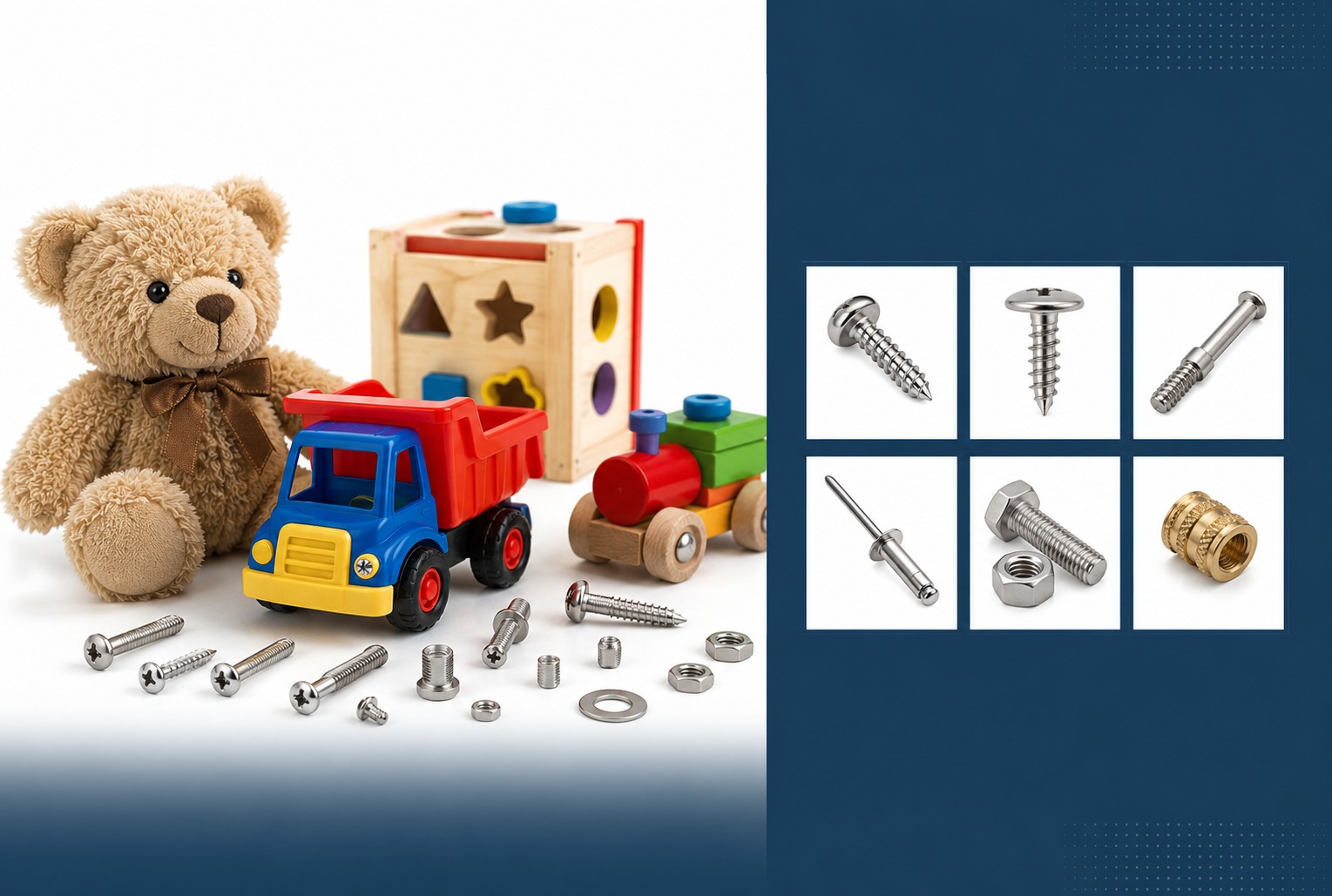
Fasteners are important components in toy manufacture since they offer the strength, stability and security required to make toys safe and functioning throughout continuous usage. Toys go through continual handling, movement, collisions and stress during play, thus the reliability of fastening systems is vitally crucial to the lifetime of the product and the safety of the kid. Different kinds of fasteners are needed for different toy designs based on materials utilized, product size, mechanical needs, and safety norms.
Toy producers may make the best choices for safety, efficiency and longevity by knowing the typical fasteners used in toy applications. One of the most popular fasteners used in the making of toys is the screw. Screws are popular for their capacity to hold items together securely, are straightforward to build, and allow objects to be disassembled for maintenance or repair.
Self-tapping screws are quite prevalent in plastic toys since they cut their own threads as they go in. No pre-threaded holes to worry about. These screws are utilized in battery driven toys, action figures, educational items and remote controlled vehicles. Self-tapping screws offer a solid means of fastening that may save down on production time and assembly expenses. Their grip is robust to assist avoid loosening over frequent play and vibration.
Choosing the Right Fastener for Safe and Durable Toy Performance
Fasteners should not have sharp edges or points, or loose parts that youngsters may swallow. Concealed fastening systems and tamper-resistant screws are commonly selected for infant- and toddler-targeted items because they restrict access to internal components and remove minor detachable elements.
The sort of fastener used in the toy depends greatly on the material it is made from. Fasteners for plastic toys must be developed for thermoplastics so that they will not fracture, peel or distort during installation.
At Fastener World (India), we provide a wide range of industrial fasteners suitable for toy manufacturing applications, including self-tapping screws, machine screws, stainless steel fasteners, bolts and corrosion-resistant fastening solutions. Selecting the appropriate fastener helps improve toy safety, durability and long-term product performance across different applications.