Anchor Fasteners for Heavy Machinery Installation: Selection and Safety Guide
Introduction
Heavy equipment requires a secure, solid base. Whether it is a press machine, pump, compressor, generator, conveyor or perhaps even an industrial motor, the heavy equipment that is being employed must remain securely positioned during the entire operation. If the machine is not anchored properly, it may move, vibrate, become misaligned or provide safety hazards.
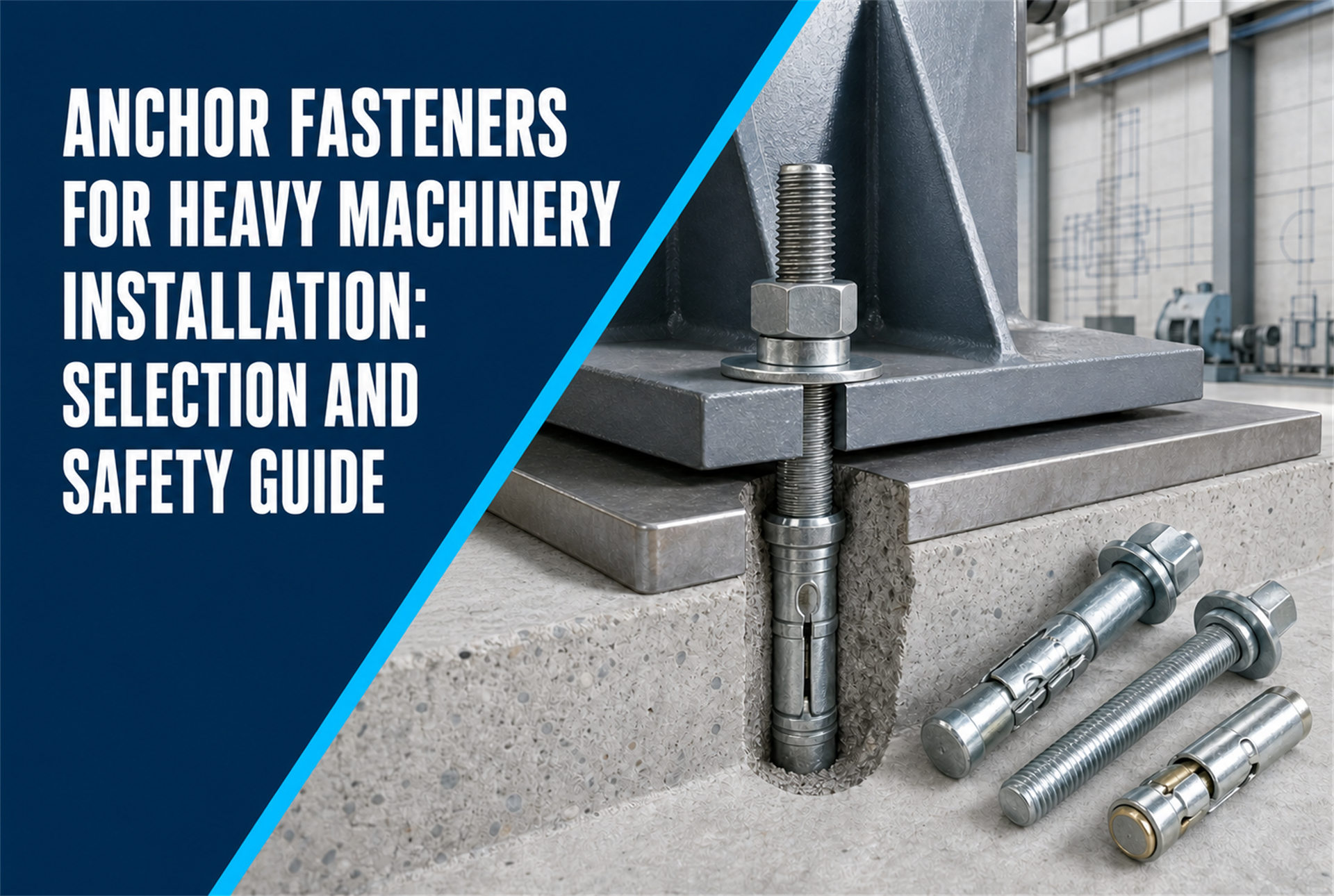
This is when anchor fasteners come into play. Anchor fasteners are used to anchor machines to concrete floors, foundations, base plates or structural supports. The correct equipment securely anchors transfer load, controls movement and enhances long-term performance.
When choosing anchors for heavy gear, it is not enough to just pick a big size. Machine weight, vibration, foundation material, load direction, installation depth, corrosion exposure and maintenance demands must be considered by buyers and engineers.
What is an Anchor Fastener?
Anchor fasteners are fasteners used to secure components in concrete, masonry or other foundation materials. In equipment installation they bolt the machine base plate to the floor or foundation.
Common varieties include wedge anchors, sleeve anchors, chemical anchors, anchor bolts, foundation bolts and high duty expansion anchors. Some anchors extend within the drilled hole, others bind to the foundation material using chemical resin.
Industrial fasteners used to secure machines must be picked carefully since they normally bear static stress, vibration load and occasionally impact force. If an anchor is improper it might loosen over time or harm the surrounding concrete.
Why Anchoring is Important for Heavy Machinery
When heavy machinery are used, they produce force. Motors spin . Presses provide pressure . Pumps generate vibration . Compressors cycle . If the machine is not fastened properly this movement might impair the alignment, product quality and operator safety.
Poor anchoring might potentially harm the foundation. Loose anchors may increase hole size, break concrete, damage base plates and raise maintenance expenses. In certain circumstances the movement of the machine may impact linked pipes, electric wires or other adjacent equipment.
Proper machinery anchors keep equipment level, stable and safe while operating. They also decrease vibration problems and enhance service life.
Verify Load and Base Material
The first step in choosing anchor fasteners is to know the machine load. This comprises the machine weight, operating force, vibration level and any other load generated during manufacturing.
A stationary machine may primarily impose static loads, while rotating, reciprocating or impact-producing equipment can generate dynamic loads.
The concrete state is the same. Strong concrete may retain anchors better whereas weak, broken or thin concrete may not provide adequate grip. Check grade of concrete, thickness of slab, edge distance and if concrete is cracked or uncracked.
For heavy-duty equipment, you shouldn’t have to guess about anchor size or grade. The load requirement should be verified with machine supplier, foundation drawing or engineering calculation.
Choose the Proper Anchor Type
Different equipment applications need different kinds of anchors. Wedge anchors are often utilized in solid concrete and offer great holding force via expansion. They are ideal for various medium to heavy load applications.
Sleeve anchors are more adaptable and operate in concrete or masonry, but may not be the ideal solution for particularly large vibration-based equipment.
The threaded rod or stud inside the drilled hole is bonded with resin using chemical anchors. They are beneficial when high load capacity is desired or where expansion pressure needs to be decreased. Foundation bolts may be utilized in planned equipment foundations when the bolts are cast into concrete.
The choice of the proper anchor type is determined by load, concrete condition, installation technique and if the machine could require future relocation.
Account for Vibration and Movement
One of the greatest headaches when you’re installing large equipment is vibration. Even a robust anchor might come free if the joint is not intended for the vibration.
Continuous vibration may be produced by machines including compressors, pumps, presses, crushers and motors. In such instances anchor fasteners must be provided with proper nuts, washers, base plates and locking systems.
Depending on temperature, load and service situation, spring washers, lock nuts, Nylock nuts, all-metal lock nuts or thread-locking compounds may be considered. The machine must be leveled and aligned before final tightening.
Hole Preparation and Embedment Depth
The quality of the installation has a great impact on the functioning of the anchor. The drilled hole should be of the proper size for the anchor diameter and embedment depth needed. If the hole is too shallow the anchor may not reach maximum holding power. If the hole is too big the anchor may not set properly.
An expansion anchor needs the hole to have the suitable size and depth. Hole cleaning becomes much more critical with chemical anchors, since dust might interfere with resin bonding. Holes should be cleaned as per specified procedure prior to anchor placement.
Coating and Material Selection
Machinery anchor fasteners must be chosen according to strength and environment. Mild steel anchors may be acceptable for light to medium loads in dry interior locations. If more strength is needed, high tensile anchors are used.
Zinc Plated anchors provide minimal corrosion protection for indoor or light exposure use. Hot dipped galvanized anchors are more suitable for outdoor or wet conditions. Stainless steel anchors are favored in corrosion-prone settings, chemical facilities, wash-down regions, food processing areas and seaside sites.
Safety Tips for Installation
The machine base plate must be correctly positioned and level before equipment anchors are installed. The anchor holes have to be aligned properly with the base plate. The forced alignment may induce stress in the anchor or the machine frame.
If torque values for the anchors are available, tighten anchors to the suggested values. Under-tightening may lead to movement; over-tightening can damage threads, anchors or concrete.
The machine must be inspected during trial operation after installation. Any abnormal vibration, movement, or loosening should be rectified quickly.
How To Select The Right Anchor?
Wedge anchors are commonly used for a robust fastening in excellent grade solid concrete. For applications that need a high load capacity, deep embedment or low expansion stress, chemical anchors may be considered. Plan machine foundations and pre-select foundation bolts before erection.
When selecting anchors for vibration-heavy equipment, consider locking techniques and adequate base plate support. In corrosive situations, stainless steel or custom coated anchors may be necessary.
Buyers should verify machine weight, kind of load, state of concrete, diameter of anchor, depth of embedment, material, coating and method of installation before purchase.
Conclusion
Anchor fasteners are vital to safe and dependable heavy machinery installation. The correct machinery anchors assist maintain equipment stable, in line and secure while in operation. A faulty anchor choice may lead to loosening, vibration difficulties, concrete damage and safety hazards.
The choice should be determined by machine loading, vibration, base material, kind of anchor, depth of embedment, exposure to corrosion and quality of installation. Fastener World (India) can aid purchasers in choosing the proper size, material, coating and specification for bulk needs of anchor fasteners, machinery anchors and other industrial fasteners depending on their application.