Bolt Grades Explained: 4.6, 8.8, 10.9 and 12.9 Fasteners
Introduction
Almost all industries employ bolts to firmly hold two or more components together. Bolts are used in machinery and fabrication, construction, automotive, furniture, electrical equipment and heavy engineering to make sturdy and durable assemblies. However, all bolts are not the same. A bolt that works well in a light-duty application may not perform well in a heavy-load or high-stress application.
This is when the bolt grades come into play. In this article, we’ll go over the various bolt grades and how to choose the best one for your application.
Understanding Bolt Grades
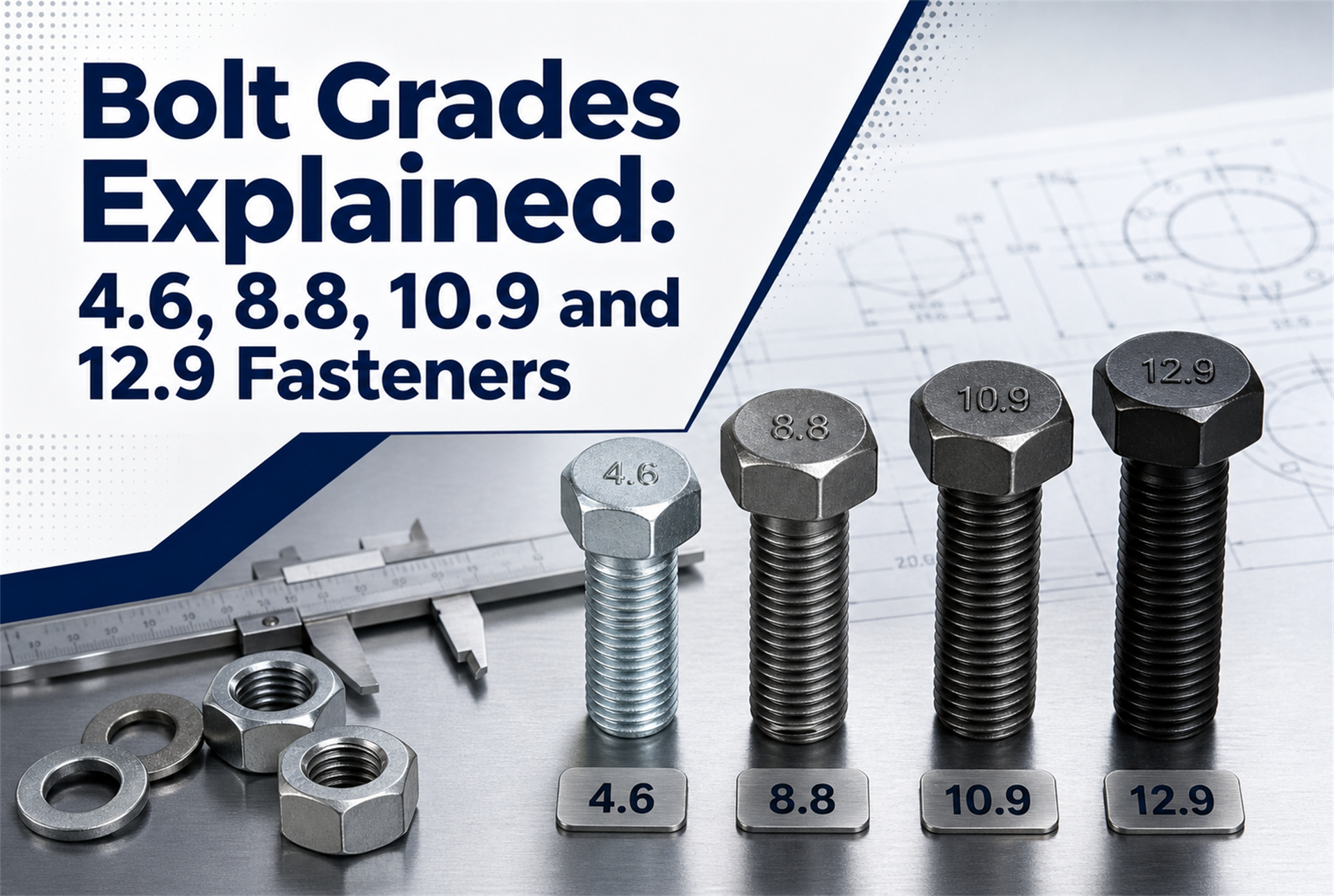
A bolt grade indicates the strength class of a bolt. In metric bolts, grades such as 4.6, 8.8, 10.9 and 12.9 are used to show the relationship between tensile strength and yield strength.
The first value is the estimated tensile strength of the bolt. Tensile strength is the greatest stress a bolt can bear before it breaks. The second value represents the yield strength, the point at which the bolt begins to irreversibly distort.
For example, a grade 8.8 bolt is stronger than a grade 4.6 bolt. Grade 10.9 bolt is stronger than grade 8.8, and grade 12.9 is one of the highest common strength classes for industrial fasteners.
Grade 4.6 Bolts
Grade 4.6 bolts are low to medium strength bolts used in light-duty applications. They are often built of mild steel and are suited for assemblies not requiring particularly high stress.
These bolts are common in furniture, light manufacturing, general fittings, brackets, clamps and non-critical assemblies. They are inexpensive, convenient to use and may be used in situations where the need for great strength is not present.
Grade 4.6 bolts should not be utilised in heavy equipment, structural joints, automotive load-bearing parts and applications with strong vibration or stress. They are excellent for basic fastening when the bolt is not anticipated to bear significant weights.
Grade 8.8 Bolts
Grade 8.8 bolts are high tensile bolts and are one of the most prevalent fasteners used in industrial applications. These give a good blend of strength, availability and affordability. They are, thus, frequently employed in machinery, construction, automotive, equipment manufacture and heavy fabrication.
These bolts are normally medium carbon steel and heat-treated for increased strength. Grade 8.8 bolts may be used in many typical engineering applications and they can take more loads than grade 4.6 bolts.
Grade 10.9 Bolts
These bolts are used rather often when the joint fastened is subjected to increased pressure or movement, impact or vibration. Grade 10.9 bolts are often used in essential machine parts, automobile chassis components, industrial equipment and in situations where joint strength is particularly vital.
The grade 10.9 bolts are tougher and stronger but must be properly picked. For avoiding joint failure, proper tightening tension, matching nuts and right washers are necessary. The use of an inappropriate mating component might diminish the efficacy of the bolt assembly.
Grade 12.9 Bolts
Grade 12.9 bolts are exceptionally high strength fasteners that are utilized in critical and heavy-demanding applications. They are intended for situations where maximum strength is needed in a small fastening area.
They are utilised in heavy machinery, die and mould equipment, automotive performance, industrial presses, high load assemblies, precise engineering and others. They have good tensile strength and are appropriate for mechanically demanding circumstances.
However, not every application needs grade 12.9 bolts. Sometimes, a really strong bolt without correct design considerations might produce problems. These bolts might be less forgiving under certain circumstances and need careful installation, good torque control and adequate mating parts.
Key Differences Between Bolt Grades
The difference between these classes is mostly the strength. 4.6 is ideal for light-duty applications. Grade 8.8 is appropriate for common high tensile applications. Grade 10.9 is suitable for heavier industrial and automotive applications. Grade 12.9 is utilised in situations requiring extremely high strength.
The higher the grade the stronger the bolt. However, the greater the grade, the higher the cost and the more stringent the installation standards. Therefore, the highest grade is not necessarily the best bolt grade. The proper grade is the grade that meets the application requirement
A grade of 8.8 is suitable for most ordinary industrial applications. Grade 10.9 or 12.9 may be necessary for large equipment and high-load assemblies. Grade 4.6 may be acceptable for light fixtures and non-critical assemblies.
The Importance of Matching Nuts and Washers
Nuts and washers must be compatible with the bolt grade. A high-strength bolt should be paired with a suitable nut and washer so that the entire fastening assembly performs as intended. They also assist in spreading the weight and protecting the surface of the material being connected. Hardened washers may be necessary for high-strength assemblies to maintain the correct clamping force and avoid damage to the surface.
A full system should be chosen as a fastener assembly at all times. Final performance is affected by bolt grade, nut grade, washer type, coating, and manner of tightening.
Coatings and Corrosion Protection
The grade of a bolt informs us of its strength, but not necessarily its corrosion resistance. If you have a very good bolt, but it is exposed to moisture and chemicals or outside conditions, without any protection, it might still break early.
When it comes to outdoor, marine or chemical settings, purchasers should consider both grade and coating. A grade 8.8 or 10.9 bolt with the appropriate coating may operate better in corrosive circumstances than a high-strength bolt with no protection.
How To Pick The Right Grade
First, know the application so you can choose the proper bolt quality. Check the load requirement, vibration, working environment, material to be connected and safety relevance of the joint.
Grade 4.6 may be acceptable for light-duty assemblies. Grade 8.8 is a good option for general industrial and mechanical applications. Grade 10.9 may be superior for heavy-duty machinery and automotive applications. For important joints of high strength, the 12.9 grade might be considered.
Also crucial is to verify the standard, size, thread type, coating and installation procedure. If the application is vital, the bolt grade should be determined by technical design and not by availability or cost.
Conclusion
Bolt grades 4.6, 8.8, 10.9 and 12.9 are used to determine the strength and performance level of metric bolts. Every grade has a function. Grade 4.6 is acceptable for light duty, grade 8.8 is suitable for numerous industrial applications, grade 10.9 is utilized for heavy-duty, high-load assemblies and grade 12.9 is used for essential high-strength needs.
The safety, dependability and service life are increased by the proper choice of bolt grade. Buyers should evaluate not only the grade but also the coating, the compatibility with nuts, the choice of washers and the environment in which the product will be used.
Fastener World (India) can assist you in finding grade, size, finish and standard for your application with bulk high tensile bolts, hex bolts, socket head bolts, nuts, washers and other industrial fasteners.