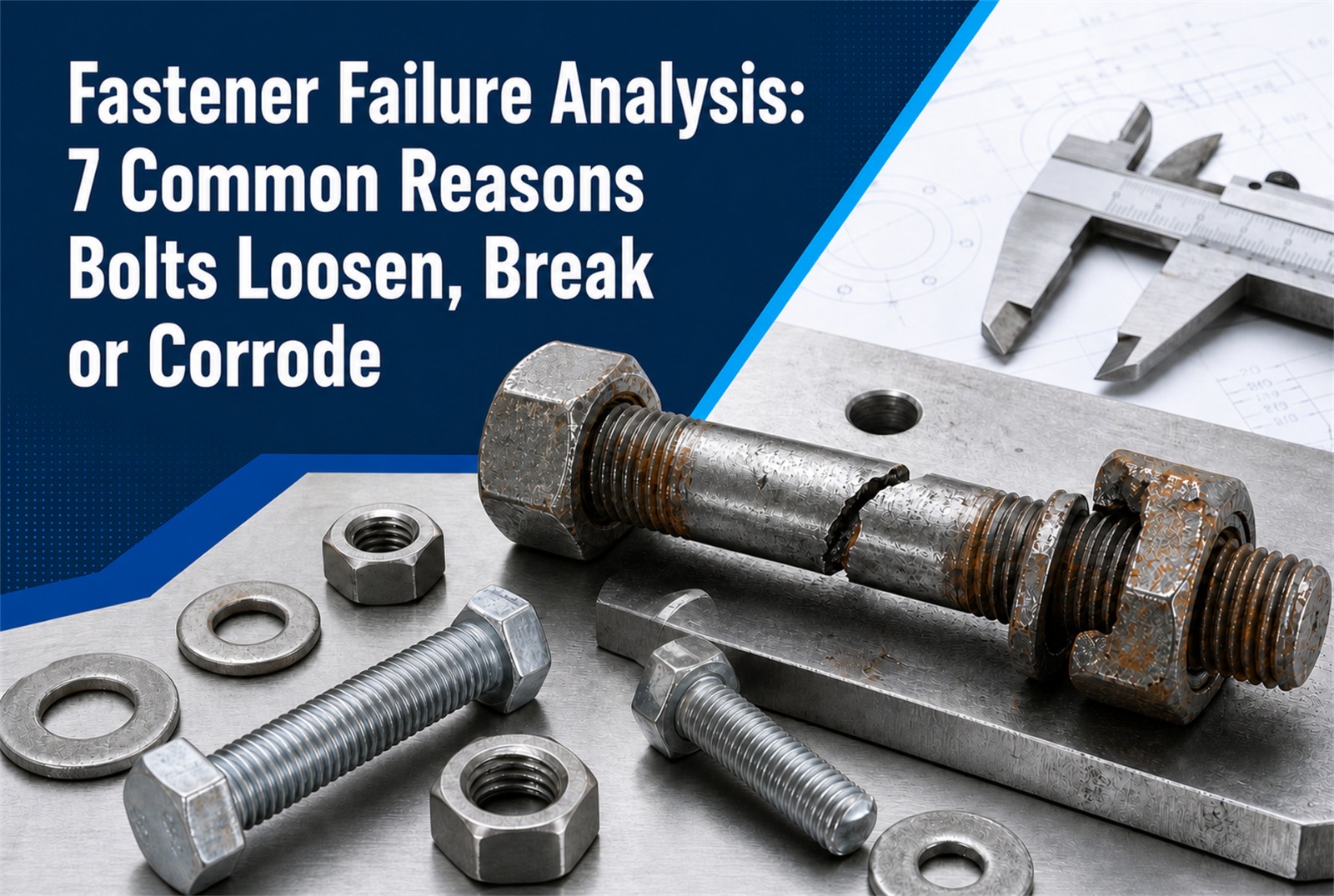
Fastener Failure Analysis: 7 Common Reasons Bolts Loosen, Break or Corrode
Introduction
Fasteners are important elements in the building, automotive, industrial, energy and infrastructure sectors. They are mostly used to firmly link two or more elements together and provide structural integrity under changing loads and operating circumstances. However, fastener failures may occur due to faulty installation, too much force, severe conditions or insufficient maintenance.
The right fastener selection, accurate installation, regular inspection and preventive maintenance combination must be used to avoid fastener failures. By knowing all the possible reasons due to which bolts come loose, break, or corrode, organisations can make their equipment more reliable, decrease downtime, and make the workplace safer. Collaborating with trusted manufacturers of fasteners in India, and following the best practices in the industry, can further help in delivering durable fastening solutions from fasteners manufacturers in India across a broad spectrum of industrial applications.
Here are seven of the most common reasons bolts loosen, break or corrode and what actually helps prevent each one.
1. Picking The Wrong Grade
This may be the most common reason for failures. There is a certain grade on each and every bolt or screw, and employing the wrong grade for the job is a mistake that invites disaster as the bolt will either stretch, deform or even break.
A grade 4.6 bolt can be used in light applications, but it is definitely not meant to handle any high-tension applications such as heavy machinery and structures, which require grades 8.8, 10.9 and 12.9.
The same rationale works for stainless bolts. The SS 304 grade stainless can be employed under ordinary circumstances, but if it is used close to sea, in chemical processing plants or wherever corrosive environment is expected, then the grade should be increased to 316.
2. Getting The Torque Wrong In Either Direction
A bolt has to be tightened to a precise degree because under-tightening and over-tightening both pose difficulties. When under-tightened, the clamping force is inadequate to hold the connection, and the joint will slip, vibrate, loosen, and eventually fatigue.
It may even fail on the spot when installing. Fortunately, the solution is clear-cut, but it is not always applied: the right torque requirements, tools, and procedure should be observed, particularly in any area where safety is an issue such as in machinery, automotive, or construction applications.
3. Vibration And Constantly Changing Loads
Dynamic loads are trickier than static ones precisely because they keep changing. A fastener can be more than strong enough for a fixed load and still fail once it’s exposed to constant movement, shock, or repeated stress cycles.
Spring washers, lock nuts, nylock nuts, thread-locking compounds, double nuts, or purpose-built locking fasteners all help here which one makes sense depends on the load, temperature, and how the equipment is actually used.
4. Corrosion And Rough Environments
The corrosion process will most probably be the most visible one, as it is quite easy to predict it. Wetness, chemicals, saline air or industrial vapors – subject the bolt or any other part to these factors for some time, and the surface will rust or pit, gradually eroding its cross-section to create something that looks stronger than it really is.
An unprotected mild steel fastener will not last for long in an outdoor or damp location. While a zinc coating will do well inside or in mild surroundings, for anything else, hot-dip galvanization, stainless steel or some other appropriate coating will be used.
SS 304 and SS 316 fasteners are the most commonly used material for the coast, marine, chemical and food processing environments. The material and coating must be selected based on the real environment the fastener will have to survive in.
5. Using The Wrong Type Of Fastener For The Job
Even a strong fastener will fail if it’s simply the wrong kind for the application. Strength alone doesn’t guarantee it’s suited to the task.
A full-thread bolt, for example, isn’t always ideal for shear-load situations. A half-thread bolt with a plain shank often performs better there.
A self-tapping screw won’t do the job where a self-drilling screw is needed. A light-duty anchor has no place in heavy concrete fixing.
6. Not Enough Thread Engagement
Thread engagement is simply how much of the bolt and nut threads actually connect and carry load. Skimp on this and the fastener never develops its rated strength which sets the stage for stripped threads, loosening, or outright joint failure.
It usually happens because the bolt’s too short, the nut doesn’t match, the thread pitch is off, or the tapped hole isn’t deep enough. Damaged threads make it worse. Before buying, it’s worth double-checking diameter, length, thread pitch, nut compatibility and standard and for anything critical, engagement should be verified against the actual engineering requirement, not just assumed.
7. Inconsistent Or Poor-Quality Manufacturing
Fastener quality comes down to raw material, dimensional accuracy, heat treatment, threading and inspection get any of these wrong and you end up with weak threads, off-spec dimensions, patchy coating, or hidden defects that don’t show up until it’s too late.
None of this is usually visible at the point of purchase. That’s why sourcing from a trusted fasteners manufacturers in India or supplier who can back up their product with consistent quality and proper documentation matters more than it might seem.
Conclusion
Any one of these can chip away at joint strength, safety, and service life. Choosing the right fastener isn’t just a matter of size or price it means actually understanding the application, the environment, the load, and the material it needs to hold up against. Get that right, and you end up with fewer breakdowns, less maintenance, and a lot more confidence in the joint holding.
For bulk fastener needs bolts, nuts, screws, washers, anchors, rivets, studs and more, Fastener World (India) can help match the right type, grade, coating and standard to your specific application.