Fasteners for Solar Panel Mounting Systems: Materials, Coatings and Selection Guide
Introduction
Solar panel mounting methods have to be securely fastened since they will be exposed to the elements outside for years. That’s why you have to choose solar fasteners wisely. Depending on the structure and kind of installation, solar projects utilise bolts, nuts, washers, U-Bolts, self-drilling screws, anchor fasteners, clamps and threaded rods. Each fastener must be compatible with the project’s material, coating, load requirements, and climatic conditions.
In this blog, you will learn how to choose solar panel fasteners for mounting systems depending on material, coating, application and long term performance.
Why Fastener Selection Matters in Solar Mounting Systems
Solar panels are often placed on roofs, open ground, industrial sheds, carports and at height. Such systems are nevertheless subjected to outside environments over their service life. Selecting the proper fasteners increases safety, lessens maintenance, and aids in providing the extended service life that is anticipated of solar systems.
Typical Fasteners Used in Solar Panel Installations
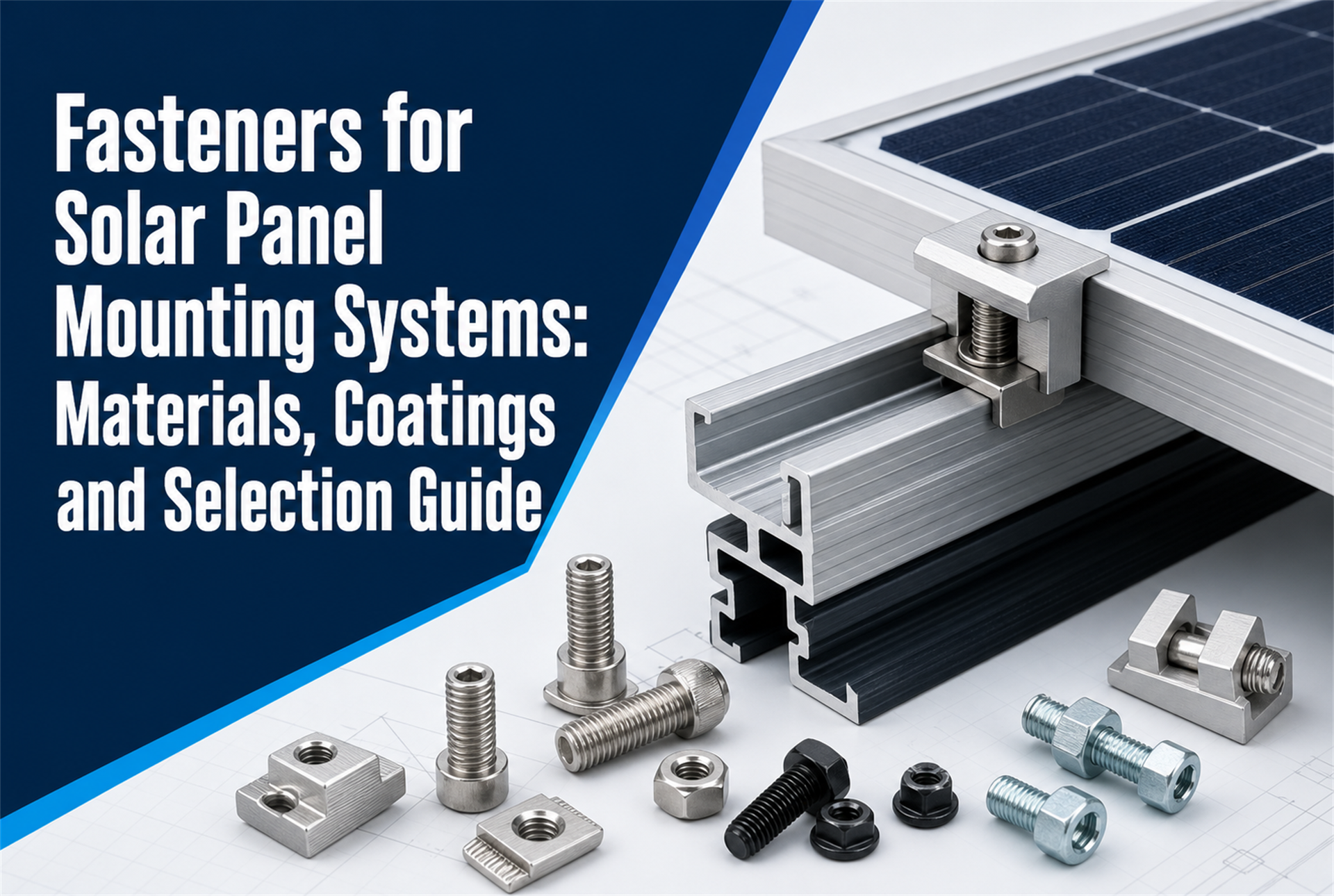
Various kinds of fasteners are utilised in solar mounting systems. Hex bolts and nuts are often used to attach rails, clamps and brackets. Washers assist spread the weight and preserve the surface when you tighten up.
Self-drilling screws are utilised for metal roof applications when drilling and fastening need to be done at the same time. Anchor fasteners could be needed when constructions are built into concrete or masonry. U-bolts may be used for pipe based or circular section supports. Customised support configurations may employ threaded rods and bolts.
Choosing the right fastener type for the application relies on the mounting structure, base material, load requirement and installation technique.
Select the Right Material
The choice of material is one of the most critical criteria for solar panel fasteners. The solar mounting systems are used outside, thus both corrosion resistance and robustness are important.
Stainless steel fasteners are often used because of superior corrosion resistance and extended service life. SS 304 is suitable for many general outdoor solar applications. SS 316 is better for coastal, marine, chemical or high-humidity situations where the danger of corrosion is greater.
Where greater tensile strength is needed, fasteners of high tensile steel may be used, but they should have a sufficient protective coating. In certain low weight systems where compatibility with aluminium rails is critical, aluminium fasteners may be employed. It is necessary, however, to examine the material compatibility to prevent the galvanic corrosion between various metals.
Select the Proper Coating
Coatings prevent fasteners from corrosion and environmental degradation. Zinc coated fasteners will work for moderate exposure or inside components, but not necessarily for long term outside solar applications.
Hot dip galvanised fasteners provide stronger corrosion protection and are often utilised in outdoor buildings. They are ideal for solar mounting frames, ground mount systems and exposed support structures.
While an extra layer is not always needed for many applications, passivation may provide a cleaner surface and more corrosion resistance. Special coatings may be necessary for tough environments depending on site circumstances.
Choose the coating according to the exposure level, estimated service life and location of the project.
Weathering Exposure and Corrosion Resistance
Corrosion resistance is an important selection criteria since solar arrays are intended to operate for many years. Rooftop solar systems may have precipitation, humidity, dust and pollution. Ground mount systems may be exposed to soil moisture, standing water and external weather. Salt-laden air may be an issue for coastal constructions.
In such settings, poor quality fasteners corrode rapidly and lead to maintenance issues. Corrosion may also weaken a fastener and make it more difficult to replace.
Stainless steel, hot dip galvanised or specifically coated fasteners are often superior than normal mild steel fasteners for long term outdoor usage. The best decision relies on the project budget, the environment and the structural need.
Load, Wind and Vibration Specification
Solar panel mounting solutions must be able to resist wind stress, dead load, installation load and occasionally vibration. Fasteners should be used to sustain clamping force under these settings.
Wind may exert uplift pressures on solar panels, particularly on rooftop and open ground installations. If the fasteners are not strong enough or if they are not fastened properly, the mounting system might become loose over time.
Critical junctions should be examined thoroughly for bolt quality, diameter, washer selection and tightening procedure. Lock nuts, spring washers or other locking mechanisms may be employed when vibration or loosening is an issue.
Compatibility of Materials
Solar mounting systems are commonly made of aluminium rails, stainless steel fasteners, galvanised steel structures and occasionally painted or coated surfaces. Galvanic corrosion may occur between two distinct metals in contact in certain circumstances.
Stainless steel fasteners used with aluminium components may necessitate the use of appropriate washers, isolation or surface protection depending upon the exposure environment.
Rooftop Versus Ground Mounted Solar Systems
Rooftop and ground-mounted solar systems have different fastening requirements. Ground-mounted systems may require anchor fasteners, hot-dip galvanized bolts, U-bolts, threaded rods and heavy-duty nuts.
Rooftop and ground-mount systems are installed under different circumstances, thus you should not use the same fasteners for every job.
Tips on Installation & Maintenance
Fasteners should be tightened appropriately throughout the installation. Loose, you could get movement, too tight, you might damage panels, clamps, rails or roof sheets. For major joints, torque measurements should be observed if available.
Use washers to spread the load and protect surfaces, where necessary. In roof sheet applications, sealing washers may be necessary to prevent leakage.
During maintenance inspect the fasteners for loosening, corrosion, damaged coating or distortion. An early look prevents larger concerns with the mounting framework.
Solar Projects Advanced Fastening Solutions
Big solar installations may need more than nuts and bolts The range of advanced fastening solutions may include customised U-Bolts, unique clamps, assemblies in stainless steel, anti-loosening nuts, corrosion-resistant coatings, threaded rods, anchor systems and fasteners manufactured to specified designs.
The solutions are especially suitable for projects with distinctive roof profiles, structural designs, high wind zones or corrosion-prone regions. Working with skilled suppliers helps to match the fastener to the real site demand.
Summary
For normal outdoor solar use SS 304 or hot dip galvanised fasteners may be appropriate. SS 316 or special coated fasteners may be preferable for coastal, marine or high-corrosion environments. Also, various fixing methods can be required for roof and ground-mounted devices.
For bulk orders of solar fasteners, solar panel fasteners and other industrial fasteners, customers may get assistance from Fastener World (India) to pick the best material, coating, size and specification for their project needs.