How to Choose U-Bolts for Pipe Supports, Clamps and Structural Applications
Introduction
U-Bolts are utilised extensively in automobile assembly, construction applications, equipment, pipe supports, structural frames and clamps. A U-Bolt that is too large or small may allow the pipe to slide or cause uneven clamping. Which is correct depends on the pipe diameter, load, environment, material, length of thread and manner of installation.
What are U bolts?
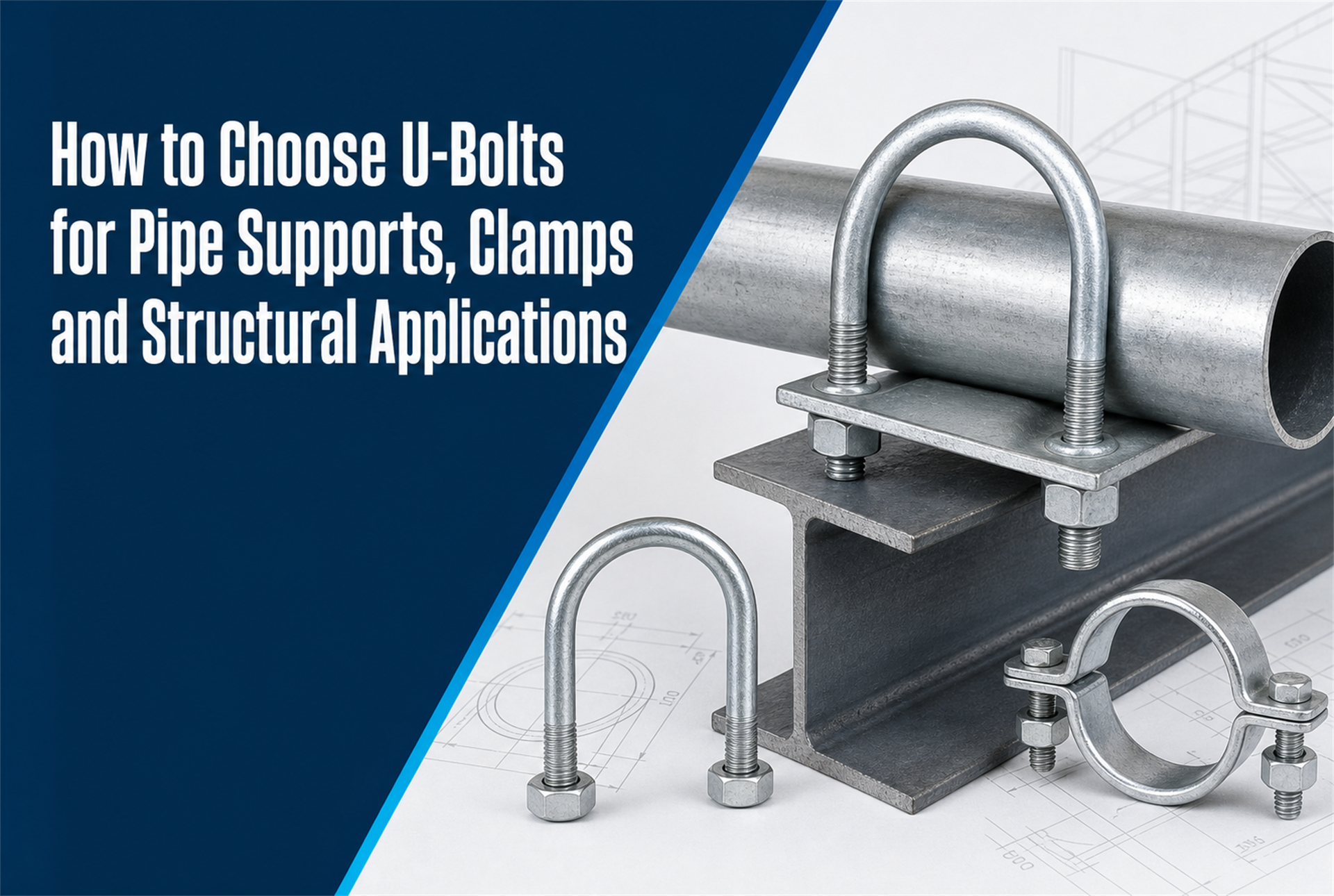
U-bolts are U-shaped fasteners with threads on both ends. These threaded ends are provided with nuts and washers to clamp or retain an item. They are most typically utilised around pipes, tubes and circular bars but may also be manufactured into square or bespoke designs.
Typical U-Bolts have a curved section, two straight legs and threaded ends. The curved portion wraps around the pipe or fitting and the threaded ends pass through a plate, bracket or support. As you tighten the nuts the U-Bolt will keep the item securely in place.
U-Bolts come in a variety of sizes, materials, thread types and finishes. Many fastener providers offer standard and bespoke U-Bolts according to pipe size, application and load need.
U-Bolts: Common Uses
U-bolts are extensively used in pipe supports for plumbing, construction, HVAC, industrial facilities and process systems. They are used to keep pipes in place and to minimise undesired movement.
They are also found in clamps, trailers, automobile suspension systems, machine frames, cable supports, maritime fittings, agricultural equipment and structural assemblies. In certain situations U-Bolts are utilised primarily for positioning purposes. In others they can bear load or withstand vibration.
Measure Diameter Of Pipe Or Tube
The first step in choosing a U-Bolt is to measure the outside diameter of the pipe or tube. The U-Bolt should have the right interior width for the pipe. The fit should not be excessively tight, because it may harm the pipe surface or make it difficult to install. If the fit is too loose, the pipe might slip within the clamp.
For pipe support applications the U-Bolt should clamp the pipe tightly without crushing it. In certain circumstances, a rubber liner, saddle plates or clamps may be utilised to protect the pipe surface and provide a more uniform load distribution.
Buyers should verify the actual outer diameter, not only the nominal pipe size, since various pipe standards might have different dimensions.
Understand the Load Requirement
One of the most critical selecting variables is the load requirement. If a U-Bolt is merely used to place a light pipe, it may not need to be as strong as one used in a structural or load carrying application.
The load might be vertical, horizontal or vibration-based. Pipes that convey fluids, gases or chemicals may gain weight in service. Equipment movement, heat expansion and vibration may further impact the load on the U-Bolt. The U-bolt should be selected with an appropriate load capacity and safety factor based on the application.
Pick The Right Material
Where more strength is needed, high tensile steel U-Bolts are employed. They are suited for equipment, structural assembly, automotive applications and high duty clamping.
Stainless Steel U-Bolts are the solution where corrosion resistance is a factor. They are utilised extensively in outdoor, maritime, food processing, chemical and extreme moisture situations. SS 304 is used in many general corrosion resistant applications while SS 316 is used for coastal, marine or chemical exposure.
Select the Proper Coating
U-Bolts are coated to guard against corrosion and increase service life. Zinc coated U-Bolts are ideal for indoor or moderate exposure applications. They provide basic corrosion protection and a clean finish.
Hot dip galvanised U-Bolts are excellent for outdoor, construction and infrastructure applications due to the thicker and more robust coating. Black oxide, phosphate or other finish may be utilised based on appearance or application need.
For severe service stainless steel or custom coated U-Bolts may be superior than normal plated steel.
Check The Length Of The Thread And The Length Of The Leg
The length of the thread and leg must be chosen according to the thickness of the plate, bracket or support through which the U-Bolt is to pass. If the threaded section is too short the nut may not thread well. If the legs are excessively lengthy, the installation can be overly bulky or not fitting.
The engagement of the thread is vital for clamping safety. The nuts must be thoroughly engaged with the threads and washers should be used as needed to spread the load and protect the surface.
Buyers should check the interior width, inside height, rod diameter, thread length and overall length before buying.
Round Bend vs. Square Bend U Bolts
The most prevalent are the round bend U-Bolts, which are used for pipes, tubes and round bars. Their curved design fits around cylindrical items, giving an equal grip.
Square bend U-Bolts are utilised for square sections, channels, beams and flat sided components. They are more suited to non-circular object shapes.
The correct bend type will provide you better clamping efficiency and less movement. Where a square bend design is more appropriate then do not impose a round U-Bolt on a square section.
Tips for Installation
U-Bolts must be fitted with the right choice of nuts, washers as well as support plates. The tightening needs to be equal on both sides, so that the clamping force remains balanced. Uneven tightening might cause the pipe or bracket to be pulled out of alignment.
Be careful not to over-tighten, particularly with thin-walled pipes or fragile materials. Too much force might deform the pipe, damage coating or cut short the service life. Lock nuts, spring washers or other locking techniques might be considered for vibration prone applications.
Summary
Selecting the appropriate U-Bolts involves more than just matching the fundamental form. Buyers should verify pipe diameter, load requirement, material, coating, thread length, bend type and installation condition. The U-Bolt to the right provides better clamping strength, alignment and long-term performance.
Zinc coated mild steel U-Bolts may be acceptable for indoor use. Hot dipped galvanised U-bolts are best for outdoor or construction applications. Stainless steel U-Bolts are often used in marine, chemical or corrosive settings.
Fastener World (India) can enable the customers to choose the proper size, material, finish and specification as per their application for bulk needs of U-Bolts and other industrial fasteners. Fastener suppliers may also assist specialised U-Bolts for pipe supports, clamps and structural needs.