How to Select Fasteners for HVAC Applications
Fasteners are crucial to HVAC systems, securing connections between ducts, support structures, compressors, air conditioning units and ventilation assemblies. These systems are subjected to environments of vibration, temperature change, moisture and continual mechanical stress, and hence the right selection of fasteners is critical to long term performance and safety.
Wrong or low quality fasteners may cause air leaks, structural instability, loosening due to vibration and higher maintenance needs in time. HVAC systems are often deployed in locations that are subject to humidity, condensation, weather conditions and variable temperatures. Fasteners used in such applications must consequently offer exceptional corrosion resistance, high clamping force and long term endurance.
Importance of Fasteners in HVAC Systems
Although fasteners are relatively small components, they play a critical role in HVAC system performance and stability. This is because the general performance of the system depends on the stability and dependability they provide greatly. HVAC equipment comprises heavy equipment such as compressors, air handlers, condensers, duct systems, rooftop units and ventilation assemblies. These parts should be tightly linked to supporting structures to avoid movement and instability.
The secure fastening ensures tight seals that guarantee air flow integrity and increase overall energy performance. Another important reason fasteners are critical in HVAC systems is vibration control. Fans, blowers, motors, compressors and other mechanical components create vibration constantly throughout operation. Over time these vibrations may weaken improperly secured connections and can cause noise, instability and wear.
Specialized fasteners, locking systems, vibration resistant nuts, and isolation mounts assist to reduce these problems by keeping connections secure under dynamic situations. Effective vibration management promotes system stability and increases occupant comfort by decreasing rattling and operating noise.
Factors to Consider When Selecting HVAC Fasteners
From ducting and insulation to compressors and rooftop units, fastening solutions are required to preserve stability and performance of all components in the system. Improper selection of fasteners may cause corrosion, structural deficiencies, air leakage, high noise levels, vibration difficulties and higher maintenance costs. Aluminum parts when used with carbon steel fasteners may corrode rapidly in humid environments.
Matching the fastener material to the base materials helps to avoid corrosion and gives long term structural integrity. Another important feature is corrosion resistance . HVAC systems are subjected to moisture , humidity , condensation and external weather conditions . Condensation occurs often in cooling systems and rain, UV, pollution and temperature swings are common on rooftop hvac equipment.
Corroded fasteners might weaken over time and threaten system stability. Environmental variables impact HVAC fastener performance.
Materials and Coatings Used in HVAC Fasteners
Galvanized steel fasteners are used in HVAC applications since they provide the strength of carbon steel with increased corrosion resistance. Galvanized simply means that a protective coating of zinc has been applied to the surface of the steel . This provides a barrier between the moisture and the metal underneath it , preventing the oxidation process. Zinc-coated fasteners are used extensively in ducting, indoor ventilation systems, and commercial HVAC assembly.
The zinc coating serves as a sacrificial barrier, corroding before the basic steel substance and therefore increasing fastener life. Galvanized fasteners are a cost efficient choice for moderate environments needing good corrosion protection, but not extensive exposure. Hot-dip galvanized fasteners give more corrosion protection than ordinary zinc plated fasteners.
During this procedure, steel fasteners are dipped in molten zinc, generating a thicker and more lasting protective coating. Hot-dip galvanized fasteners are often utilized in outdoor HVAC systems, rooftop equipment installations and industrial situations where exposure to moisture and weather is more severe.
Common Fasteners Used in HVAC Applications
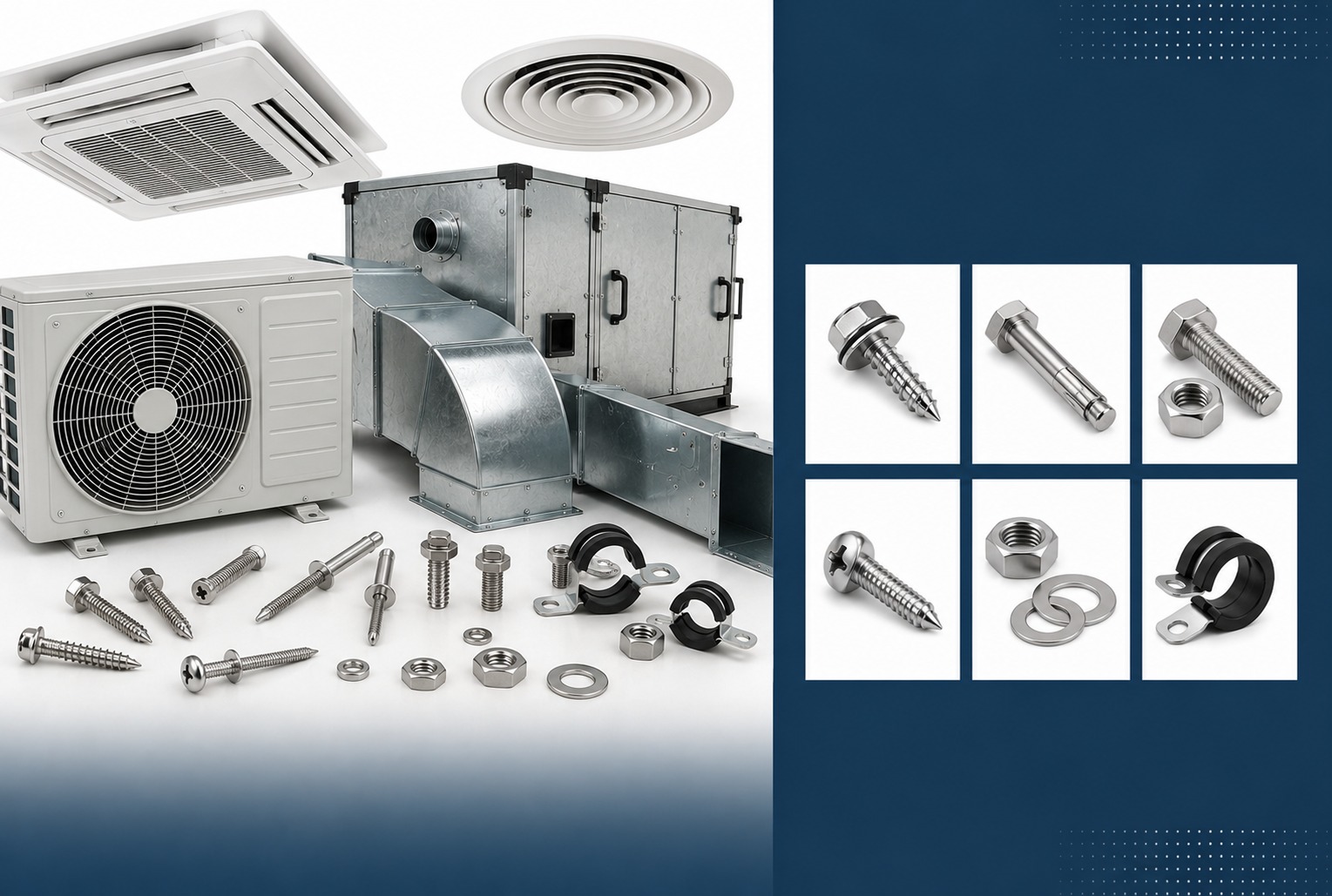
These fasteners are designed to integrate the functions of drilling and threading into one component, enabling the installer to drill pilot holes and attach materials at the same time. Self-drilling screws are particularly beneficial in commercial HVAC systems for mounting metal components when speed and productivity are essential. The drill-point design enables them to pierce steel, aluminum and other materials without separate drilling processes. This minimizes labor time, and makes installation easier in rooftop units, support systems and sheet metal assemblies.
Machine screws are ubiquitous in HVAC equipment when there are nuts or threaded holes for assembly. The screws offer accurate fixing and are widely utilized in control panels, motor assembly, electrical enclosures and equipment housings. Machine screws are offered in numerous thread diameters and head designs for diverse mechanical and structural uses. They are heavily employed in manufacture and maintenance of HVAC equipment and offer precise clamping force and secure fastening.
Bolts are important fasteners for HVAC systems that need substantial structural support. HVAC equipment including rooftop units, air handlers, chillers and compressors are large and need bolts to hold them tightly and maintain structural integrity. Hex bolts are among the most often utilized kinds of fasteners in HVAC systems because they can offer great strength and sustain substantial mechanical stresses. Bolts are often used in pairs with nuts and washers to equally distribute the load and prevent the joint from loosening during operating stress and vibration.
Choosing the Right Fastener for Long-Term HVAC Performance
At Fastener World (India), we provide a wide range of industrial fasteners suitable for HVAC applications, including self-drilling screws, stainless steel fasteners, threaded rods, bolts, nuts and corrosion-resistant fastening solutions. Selecting the right fastener helps improve HVAC system durability, installation efficiency and long-term performance across residential, commercial and industrial environments.