Self Clinching Fasteners Explained: Clinch Nuts, Clinch Studs and Standoffs
Introduction
Sheet metal assemblies need robust and dependable threaded fastening points. In many circumstances welding, tapping or loose nuts are not possible due to thin material, restricted access or the need for a precise finish to the assembly. Here self clinching fasteners might be handy.
Self clinching fasteners are inserted into sheet metal and permanently fastened in place by pressing them into the sheet metal. Once fitted, they provide you a robust thread, stud or mounting point without welding or loose hardware. They are frequently employed in electrical cabinets, electronics, control panels, automotive parts, appliances, industrial enclosures and precision sheet metal fabrication.
If you are a buyer dealing with fastener manufacturers in India or buying via a regular fastener provider, knowing about clinch nuts, clinch studs and standoff can aid in selecting the proper product for the application.
What Are Self Clinching Fasteners?
Self clinching fasteners are a specific kind of fastener that are pressed into ductile sheet metal. The fastener is driven into a properly sized hole during installation. The sheet metal flows into the undercut or locking feature of the fastener generating a secure mechanical lock.
Once inserted the fastener is a permanent part of the sheet. It offers a thread, stud, or spacing support without welding, tapping, or loose hardware. This makes assembly quicker, cleaner and consistent.
Self clinching fasteners are widely utilized in sheet metal components such as steel, stainless steel, aluminum and other sheet metals. The material thickness and hardness, however, must be compatible with the specified fastening. If the sheet is too thin or too firm, the fastener may not secure correctly.
Why Self Clinching Fasteners?
The main benefit of self clinching fasteners is that they produce strong threads in thin sheet metal. Thin sheets are difficult to tap due to insufficient substance to create reliable threads. This is surmounted by a clinched fastener by attaching a strong threaded insert or stud to the sheet.
Self clinching fasteners also provide a tidy look. The fastener locks into the sheet and does not need a loose nut to be held from the rear side during installation.
Clinch Nuts
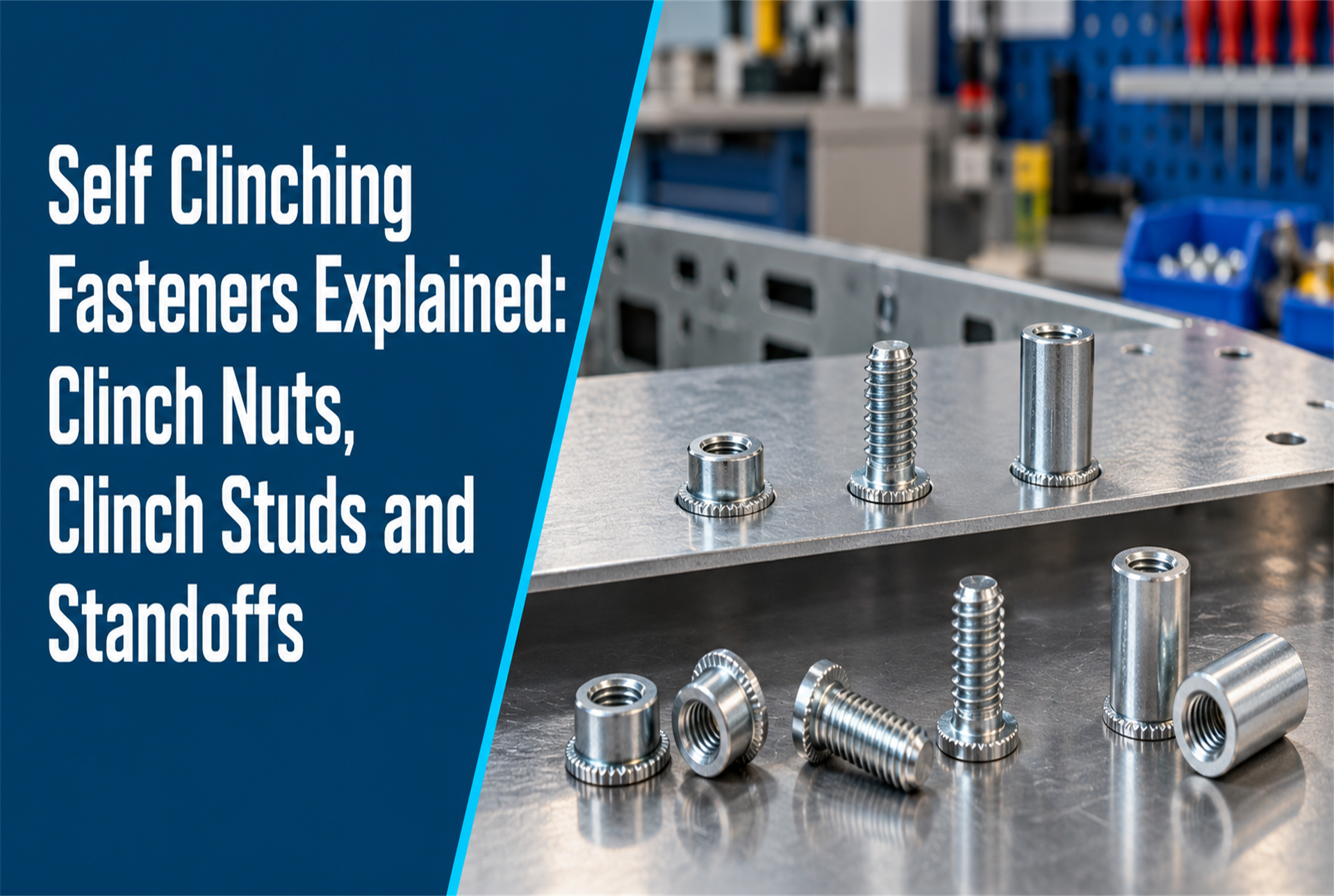
Clinch nuts are self clinching fasteners with internal threads. They are pressed into sheet metal to provide a permanent threaded hole. Once in place, a screw or bolt may be screwed into the clinch nut.
Clinch nuts are used in electrical panels, sheet metal boxes, appliance bodies, vehicle mounts, and control cabinets. They are helpful when the sheet metal is too thin to be tapped.
The clinch nut’s key advantage is that it is reproducible in assembly. Proper torque will allow screws to be removed and replaced in maintenance without harming the sheet. Clinch nuts save space compared to welded nuts or loose nut assemblies.
When buying clinch nuts, customers should think about thread size, sheet thickness, material compatibility, hole size and installation load. Since good clinching relies on material flow, sheet hardness is critical.
Clinch Studs
External-thread self-clinching fasteners are called clinch studs. They form a fixed threaded stud protruding from the sheet metal surface, rather than an internal thread. Then components installed above the stud may be fastened with a nut.
Clinch studs are utilized in mounting brackets, panels, electronics, ground points, equipment bases and automobile assembly . They are used when a permanent threaded post is required without welding a stud to the sheet.
One of the big advantages of a clinch stud is speed. Once placed the stud is locked in place and allows simpler assembly in the future. The mating component may be set down over the stud and the operators can tighten the nut without having to align a loose bolt from the other side.
Stud length, sheet thickness, material and estimated load, and thread size should be taken into account while selecting clinch studs. For vibration-prone applications, appropriate nuts, washers or locking systems may also be necessary.
Stand-offs
Standoffs are used to provide space between two components. Self clinching standoffs are pressed into sheet metal and offer internal threads or a threaded mounting post depending on the design.
They are popular in electronics, printed circuit board mounting, control panels, instrumentation and electrical enclosures. A standoff holds one part apart from another to provide clearance, ventilation, insulation, and ordered assembly.
A self clinching standoff offers a solid and precise mounting point. This enhances assembly quality and removes the need for any separate spacers or loose hardware.
Buyers should consider height, thread size, sheet thickness, load, material and electrical requirements when purchasing standoffs. For electrical applications, grounding or insulation requirements should be considered before final selection.
Material and Finishing Choice
Self-clinching fasteners are available in a variety of materials and finishes. Carbon steel fasteners are often used for typical sheet metal applications. Corrosion resistance is necessary and stainless steel fasteners are chosen. Aluminum fasteners are employed when weight reduction or material matching is desired.
The selection is completed depending on the operating environment. Zinc plating works for many interior applications. Material compatibility is highly critical. If the fastener is excessively harsh or not suited for the sheet, it may not attach properly. The sheet should be sufficiently ductile to flow into the locking function of the fastener.
Checks: Installing & Purchasing
Proper installation of self-clinching fasteners is required. The hole size must conform to the fastening specification. If the hole is too big the fastener may spin or pull out. If the hole is too tiny, installation may harm the fastener or sheet.
Apply force and firm support to properly drive the fastener into the sheet. We do not advocate hammering as it might break fastener, distort the sheet or cause irregular installation.
Buyers should not choose self clinching fasteners by thread size alone. The sheet thickness, the sheet hardness, the installation hole, the load orientation, the material, the finish and the working environment are all equally significant. Also, don’t overtighten, since too much tension might strip threads or diminish holding strength.
Conclusion
Self clinching fasteners are a great way to provide strong threads, studs and spacing points in sheet metal assemblies. Please check the fastener type, thread size, sheet thickness, material, finish, installation hole, load requirement and working environment before purchase. Fastener World (India) can cater to the needs of purchasers of self clinching fasteners, clinch nuts, clinch studs, standoffs and other industrial fasteners seeking for fasteners manufacturers in India or a fastener supplier that you can trust.