Stainless Steel 202 vs 304 vs 316 Fasteners: Complete Buyer Guide
Introduction
Moving up to a higher grade than you need might raise money without delivering meaningful benefit. Buyers should know the difference between SS 202, SS 304 and SS 316 fasteners before making an order.
If you are a company that sources from fasteners manufacturers in India or if you have a regular fastener provider, your choice of grade should be decided by the environment, exposure, budget and long term performance.
The Importance of Stainless Steel Grade
A fastener within a dry machine panel is not subject to the same circumstances as a fastener in a coastal plant, a chemical area or an outdoor building. Stainless steel is affected by moisture, salt, acids, cleaning agents and heat.
Each of the three types of fasteners, SS 202, SS 304 and SS 316, has its place, but should not be considered interchangeable for all applications.
What Are SS 202 Fasteners?
SS 202 fasteners may be utilized for light duty interior applications with little exposure to corrosion. They may be ideal for furniture, ornamental fittings, light fabrication, interior panels and dry regions when the climate is regulated.
However, the corrosion resistance of SS 202 is not the same as that of SS 304 or SS 316. SS 202 may discolor or corrode quicker in humid, outdoor, marine or chemical situations. If the application has moisture, the buyer should not choose for SS 202 just because it is cheaper.
What are SS 304 Fasteners
SS 304 Fasteners: SS 304 fasteners are the conventional option for many common industrial applications.
SS 304 fasteners are utilized in machinery, electrical panels, food processing equipment, appliances, fabrication, automobile parts and indoor industrial assembly. They do well in areas of moderate moisture exposure.
SS 304 is more corrosion resistant than SS 202 due of high nickel content and stable composition. It’s a superior option when the fastener has to survive longer and resist stains under everyday industrial circumstances
However, in the most corrosive situations such as maritime locations, chemical industries, salt exposure or heavy wash-down conditions SS 304 may not be sufficient. In such situations, SS 316 may be the recommended option.
What are SS 316 Fasteners?
SS 316 fasteners are noted for their excellent corrosion resistance. The main difference is the molybdenum content which adds resistance to chlorides, salt and many chemicals. This makes SS 316 appropriate for severe conditions.
Buyers should not replace SS 316 with SS 304 / SS 202 without evaluating the environment and technical necessity for critical application.
Major Differences and How to Choose
The primary difference in these 3 categories is the corrosion resistance. SS 202 is a basic stainless steel for use in situations with limited exposure. SS 304 has greater corrosion resistance and is used in many common industrial applications. Of the three, SS 316 is the most corrosion resistant due to molybdenum.
Then there’s cost. normally SS 202 will be the most inexpensive, SS 304 is mid range and SS 316 is normally the most costly. But the most affordable choice isn’t usually the best. If corrosion occurs early, the cost of replacing a fastener, the downtime and safety risk may be larger than the initial save.
Begin with the surroundings. SS 202 is appropriate for dry interior locations with little danger of corrosion. SS 304 is generally reliable for ordinary industrial applications with mild exposure. SS 316 is suited for coastal, chemical, marine, food processing or high moisture environments.
Then, verify the application. Cost may be more important if the fastener is utilized in a decorative or non-critical place. Reliability should be given a greater importance if employed in machinery, safety equipment, process equipment or outdoor constructions.
Common Fastener Types and Checklist for Buying
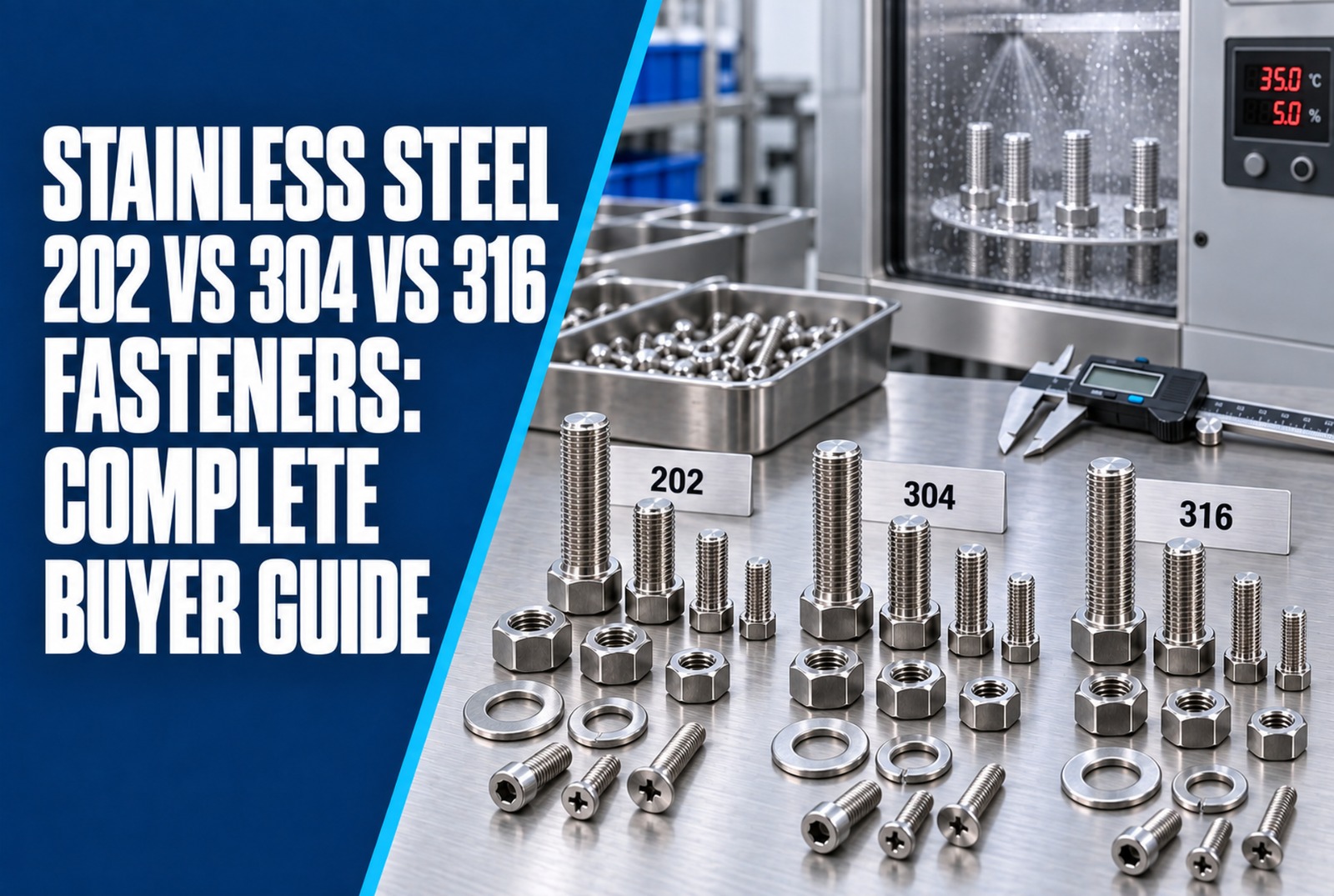
Stainless steel grades are offered for various kinds of fasteners including hex bolts, socket head cap screws, machine screws, self tapping screws, nuts, washers, threaded rods, studs, rivet nuts, anchors and unique fasteners.
The grade must fit the application and the matching material. Stainless steel nuts and washers are usually used with stainless steel bolts for better compatibility and corrosion resistance. Mixing materials in corrosive conditions might produce issues over time.
Before ordering, customers must check the stainless steel grade, fastener type, size, thread, standard, finish, quantity and application environment. They should also assess if the fastener will be exposed to chemicals, salt, heat, vibration, moisture or recurrent servicing.
A good fastener provider can assist you compare SS 202, SS 304 and SS 316 by real usage and not just pricing. Reputable fasteners manufacturers in India can also help with bulk requirements, confirmation of grades and unique fastening demands.
Summary
SS 202, SS 304 and SS 316 fasteners are all used for different purposes, but should be picked carefully. SS 202 is appropriate for low-exposure indoor application. SS 304 is a good general purpose stainless steel grade. SS 316 is suitable for severe, coastal, chemical and high moisture situations.
Fastener World (India) can assist purchasers seeking for stainless steel fasteners, SS 202 fasteners, SS 304 fasteners, SS 316 fasteners and other industrial fasteners depending on application, grade, size and quantity needs.