T-Nuts vs D-Nuts: Choosing the Right Insert for Wood
If you’re someone who is crafting a wooden table, or someone who is assembling modular furniture, or perhaps putting together a bookshelf, you will most certainly face an issue when it comes to ascertaining a strong and reliable thread that doesn’t loosen over time. Since wood isn’t able to hold machine threads that well, threaded inserts like T-Nuts and D-Nuts come into the picture.
T-Nuts and D-Nuts are able to offer metal threads inside wooden panels, which allows for bolts to be fastened without damaging the base. Despite serving a similar function, these nuts do differ in terms of how they are installed, their holding mechanism as well as material suitability.
In applications where high pull-out strength is to be prioritized in materials like solid wood or plywood, manufacturers rely upon T-Nuts. On the other hand, for applications that work with softer boards like MDF and particleboard, D-Nuts become the go-to option. Manufacturers can run into complications like spinning, loosening, or long-term joint failure in case they don’t pay enough attention while picking the appropriate inserts. Through this article, we aim to break down how they work, how they differ, and how to pick the correct one for your application.
T-Nut
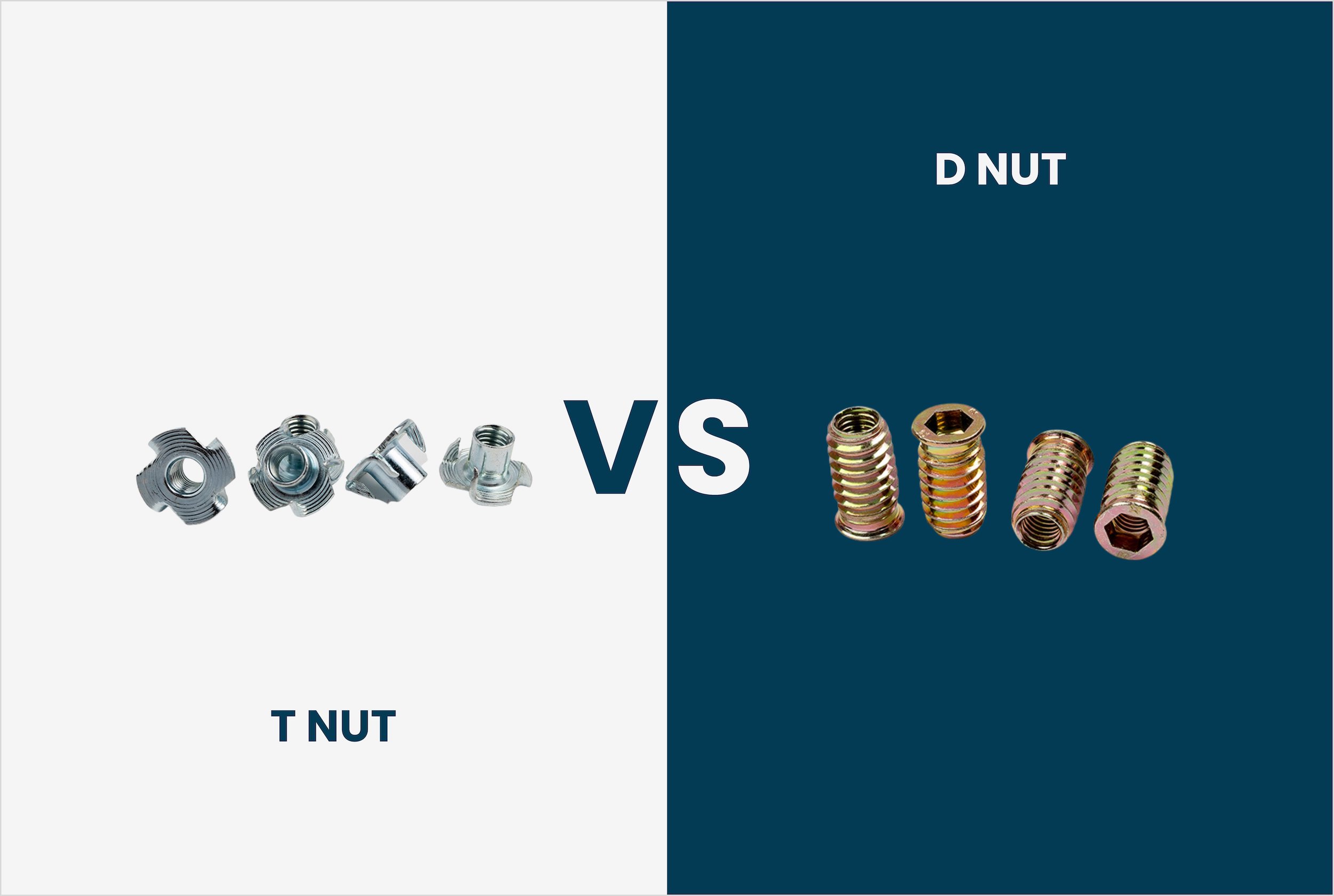
T-Nuts are disc-shaped fasteners that come with a threaded barrel at the center as well as three or four sharp prongs. For T-Nuts to be properly installed, there first must be a clearance hole that needs to be drilled. Once the hole has been drilled, the nut is tapped into the back side of a wooden panel, and when the nut is tightened from the front, the prongs are able to get a hold into the wood, helping them lock in place, and being able to prevent any form of rotation.
Owing to their design, they are able to sit flush with the surface, which makes them an excellent choice for applications where appearance is of great importance. The prongs are particularly useful in offering resistance to pull-out forces, allowing the material to be able to firmly grip the prongs.
Since T-Nuts are extremely adept at being able to handle repeated tightening and loosening, they are commonly seen in furniture legs, gym equipment, speaker cabinets, and climbing wall holds.
At Fastener World (India), our T-Nuts are made from Mild Steel (Grade 4.6) and are available in multiple sizes and finishes to suit different furniture, fixture, and light construction requirements.
D-Nut
D-Nuts, also known as screw-in inserts, are cylindrical metal sleeves with coarse external threads and a machine thread on the inside. Unlike T-Nuts, they are installed from the face side of the panel. After drilling a pilot hole, the D-Nut is screwed into the material until its collar sits flush with the surface.
The external threads cut into the surrounding wood, allowing the insert to grip along its full length. This makes D-Nuts particularly effective in engineered wood products such as MDF and particleboard, where prongs would otherwise fail to hold. Since the insert engages the material throughout its body, it offers improved stability and reduced risk of spinning during bolt tightening.
Another advantage of D-Nuts is their removability. These nuts can easily be unscrewed and be replaced without there being any major damage to the panel. This makes them extremely apt for applications that require frequent rework or modification. D-Nuts also leave a more sleek and finished look on the surface as compared to rear-installed inserts.
D-Nuts are commonly used in flat-pack furniture, cabinetry, and modular assemblies where consistent fastening and clean installation are required.
At Fastener World (India), we offer both full-thread D-Nuts and cut-thread D-Nuts options in mild steel grade 4.6, which caters to a diverse range of engineered wood applications.
Key Differences
| Aspect | T-Nut | D-Nut |
| Fixing Method | Hammered into a pre-drilled hole with the help of sharp prongs | Screwed into a pilot hole with the help of external threads |
| Retention Mechanism | Prongs bite into the wood to resist any pull-out | Outer threads grip the panel surface |
| Suitable Materials | Solid wood, plywood | MDF, particleboard |
| Installation Speed | Faster, since it needs minimal tooling | Slightly slower due to the screw-in process |
| Removal Method | Knocked out from the back | Unscrewed and removed cleanly |
| Reusability | Limited since prongs wear over time | High since threads remain intact |
Conclusion
Even though both T-Nuts and D-Nuts are a great choice when it comes to creating strong internal threads in wooden panels, their performance significantly relies upon the base material being used as well as the application requirements. T-Nuts are a superior choice for when high pull-out strength is needed in solid wood or plywood, since their pronged design offers great resistance in applications involving dense materials.
On the contrary, D-Nuts are a far greater choice with respect to softer boards like MDF and particleboard, since their design provides consistent holding strength, along with cleaner installation and better reusability, making them appropriate for applications such as modular furniture.
Eventually, the decision boils down to the type of material, access to installation as well as whether removability is a priority or not. A comprehensive understanding of these can significantly help with better joint performance, longer service life along with fewer issues during their assembly.
At Fastener World (India), we stock both T-Nuts and D-Nuts in a wide variety of sizes and threading styles, enabling you to select the most suitable insert for your furniture or construction needs.